Third Class All the Way
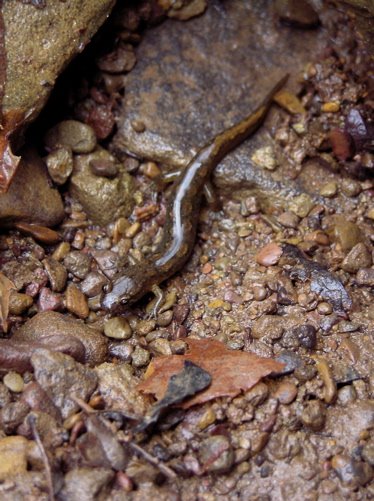 A dusky salamander, lovely little beast.
I had a wonderful adventure with my new friend Mike Austin last week. Mike is a herpetologist who works for the Ohio Department of Transportation. We met at a wildlife workshop last summer, where we were both giving presentations for the public. Only problem: No public showed up. So the presenters wound up yakking and networking happily, and my acquaintance with Mike "took." I've been sending him photos and records of herps found on our place. Surprisingly little is known about the herpetofauna of Washington County. For instance, I've found rough green snake and hognose snake on our place, and those turn out to be significant records for the county. It's nice to add little pieces of the jigsaw puzzle when you can.
As part of his work, Mike is interested in getting a conservation easement on one or both of the streams on our 80-acre property--almost as interested as we are. In order to qualify for an easement, the stream in question must be Class 3. A Class 3 stream holds water year-round. The indicator species for a year-round stream is the two-lined salamander. This animal has a larval stage that is aquatic, with gills, and takes two years or more to develop, so it won't survive in a stream that dries up in midsummer.
Mike and I figured we'd do the easy stream first--the big one with pools of water that stay year-round, the one that's been featured in my blog several times over the winter, with the fabulous ice caves. So we started flipping rocks at the headwaters.
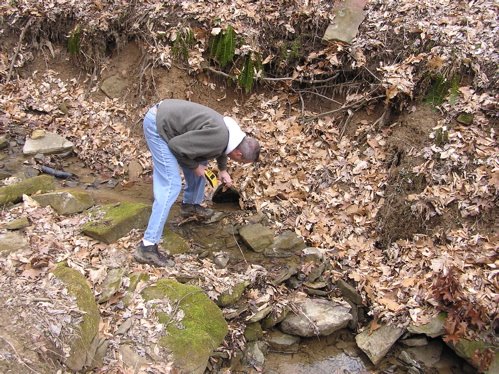 We were still flipping rocks when we ran out of stream, and in the entire length of it, we found only one dusky salamander. That's a nice little salamander, but it has a gilled larva for only 7 to 10 months, so it can survive in streams that dry up for part of the year. Hence, it's not an indicator of a permanent stream as is the two-lined salamander.
 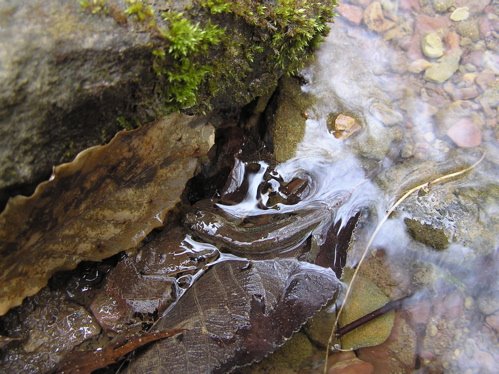 Hmm. Very strange. In fact, we were puzzled by the dearth of vertebrates in this likely-looking stream overall. We wondered if it were too cold for them to be active.
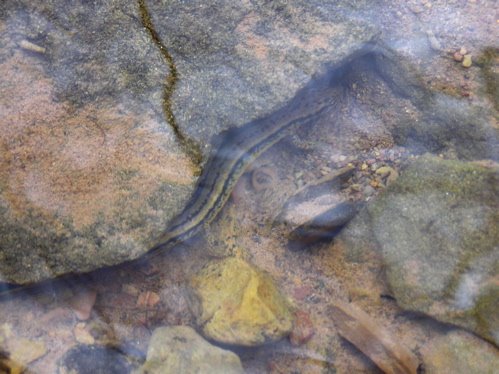
So we moved on, and hit the Loop trail, and headed down into the Chute. We started flipping rocks right away, and the difference in the two streams was stunning. We found some lovely duskies and crayfish, but we weren't really expecting two-lined salamanders, since I was pretty sure the stream dried up in droughty summers. A stone's throw from our property line, I gazed down into the water and found this lovely adult two-lined salamander lazing by a rock. It was like finding a gold nugget. "Well, here he is!" I said to Mike.
 We would find two more on our land, in our little stream, one a huge adult that disappeared down a secret tunnel when we lifted the rock.
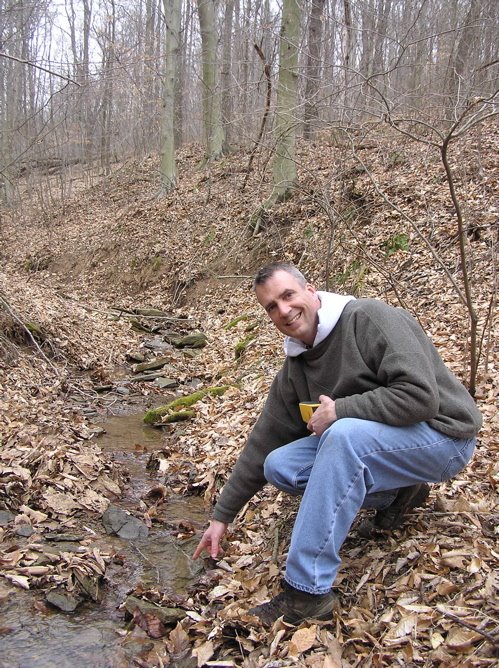 This is where we found the first two-lined salamander.Mike's happy because we've been looking for almost three hours.
Our focus shifted immediately from the big, sexy stream to the little piddly one, because that's where the creatures were. I was delighted that our humble stream proved to have adequate habitat for two-lined salamanders. But I'm puzzled and concerned about the dearth of life in the other stream, whose headwaters are on our land. I suspect some event has caused a local extinction of the salamander population, and I'm trying to figure out what that could be. I'm suspicious of an old oil well near the streambed; perhaps oil and brine are leaching into the stream. But we didn't find anything above the well, either...it is a mystery for now.
Mike and I are moving forward with the conservation easement, which is rather modest, protecting only a 30 to 50-foot corridor on either side of the little stream. But it's a start. Somehow, we hope to formalize protection of this entire precious piece of land by the time we are ready to pass it along to Liam and Phoebe. And I hope to have a whole lot more land under protection by then, too. I'm not the lottery-playing type; I want to earn this land. It sustains me and feeds my soul, and it's the inspirational source of everything I write or draw.

posted by Julie Zickefoose @ 9:56 PM






<< Home