Monday, April 24, 2006

Come Walk With Me

and we'll do a nest check. Oh, I love checking my nest boxes. It's hard to stay out of them this time of year; each time I open one it's like Easter morning.
There are baby bluebirds in many of my boxes right now, and watching them grow is absolutely riveting. The weather's been great for nesting, not too cold at night, and the rains have been brief with plenty of sun in between. I can't remember a better spring for nesting birds. So far. Exactly one year ago today, I was looking out at six inches of snow, snow heaped on green leaves and piling up atop bluebird boxes full of nestlings. Arrrrgh. I like this spring MUCH better.
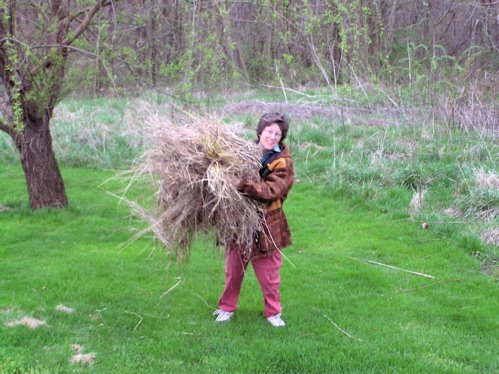
While playing the Easter bunny, I gathered grass for Easter baskets, but also for my nest boxes. I always gather a feed bag full of dry grass early in spring before it all rots down--now is too late. The fast-growing green grass and the spring rains have rotted all that good winter grass to moldy tatters. I store it in the garage and use it for nest changes. Eastern bluebirds get a parasite, the bluebird blowfly, Protocalliphora sialia. The maggots infest the nest, and suck the babies' blood at night. Almost all nests are infested, especially in the second brood, so I automatically change the nests when the babies are about a week old. I just make a new nest from dry grass and take the old one out. Then I count the maggots to see how badly infested the nest was. A bad infestation will be 75-150 blowfly larvae. I always think how good it must feel to the chicks to be blowfly-free at last. If I can't find any evidence of blowflies, I often leave early spring nests alone. By May, though, those blowflies will be busy!
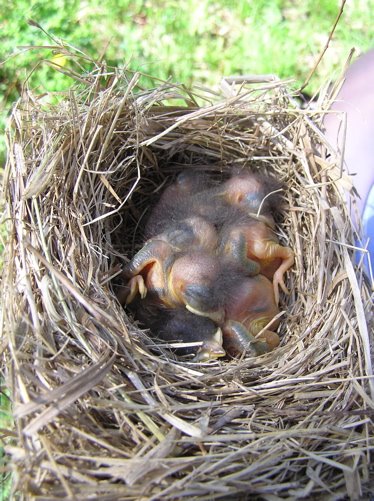
These four-day old nestlings in the Spring Trail box are almost ready for their nest change. I wait until they're big enough to handle safely. One of the eggs in this clutch hadn't hatched, so I took it out. Better that, than it cracks and soils the nest. If an egg hasn't hatched by the time its siblings are two days old, it's not going to hatch. I'm always curious to see if I can tell what went wrong, so I take the egg a good distance from the nest and open it up to see what's what. The vast majority of unhatched eggs were never fertilized, but this one died in the shell after about ten days of incubation. I don't know why, but maybe someday an answer will present itself. The thing is to keep asking the questions, and keep looking for the answers.
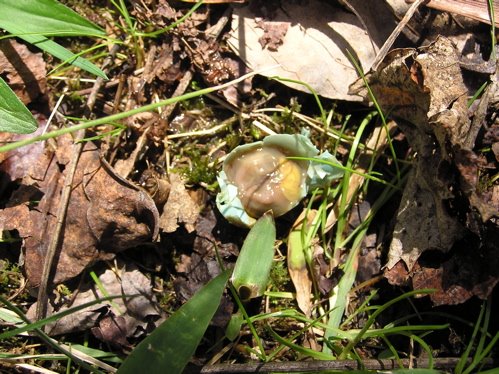
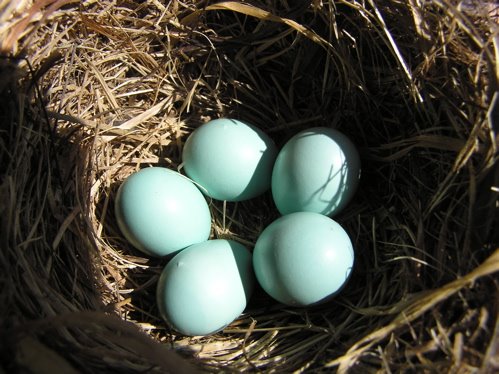
The very next box Phoebe and I checked had five eggs. If you look closely, you'll see that the topmost and lowest eggs are pipping. So now I know that the babies will all be hatched by tomorrow morning. The momentary sadness we felt over the chick that died in its shell evaporates. Life surges on in the spring.
Those of you with a hands-off appreciation of nature may be unsettled by my tales of nest intervention--removing nests, handling young birds, opening unhatched eggs. I know a man who has bluebird boxes in his yard, unprotected by baffles, who never opens them until the end of the season. He's appalled at the way I manage my boxes. He thinks I should leave the birds alone and let nature take its course. But when the bluebirds in his yard mysteriously "abandon" their nests, he doesn't know why; snakes and raccoons have their way with them; parasites weaken the young. Maybe some of his bluebirds make it. Most probably don't.

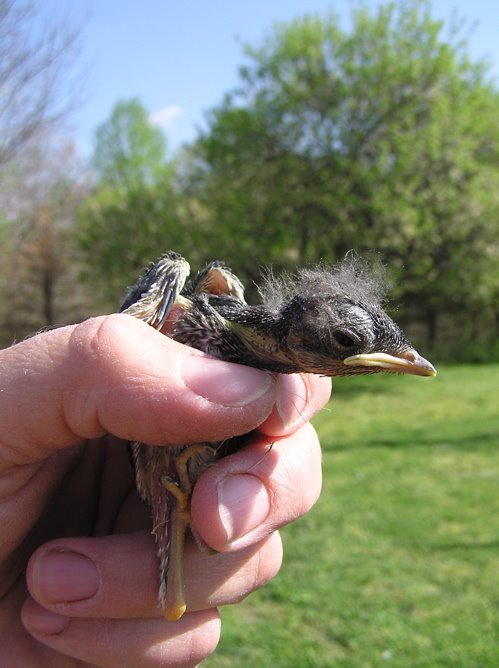
By contrast, I'm an unapologetic interventionist. I don't handle the birds for fun or profit; I handle them only to help them. Having run nest box trails since 1982, I've figured out how to help them. And I'm not above feeding them when their parents have trouble finding enough insect prey. Last year, 52 fat, healthy baby bluebirds fledged from boxes on my trail. There were a couple of snake incidents, a couple of raccoon incidents, some very cold, wet spring weather...I was trying out a waxed pole that proved emphatically not to work in Ohio! Those poles are all baffled now. In 2004, the best year ever, a whopping 72 bluebirds fledged from our boxes. This year, I'm holding my breath. It could be better than '04. We've got eight pairs of bluebirds (up from our usual total of six), a pair of tree swallows, and a pair of Carolina chickadees in boxes on our land.Here's a ten-day-old bluebird, about to be put into its new, parasite-free nest.
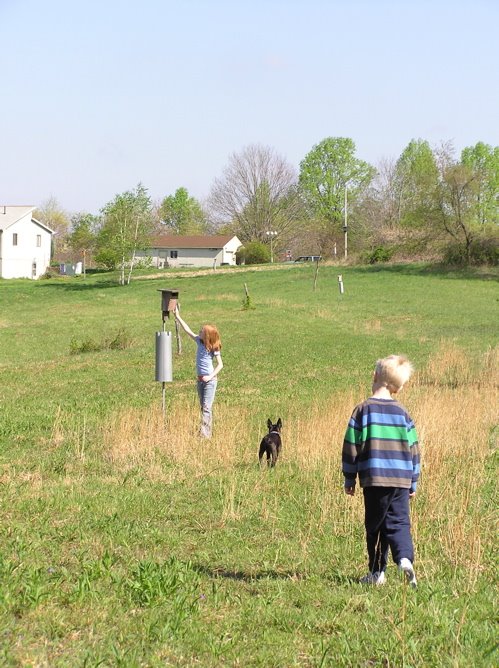
I'm as serious about pumping healthy young birds out as any farmer is about fattening cattle. I've got seven new baffled boxes up on Stanleyville Road, and another couple more to put up. And I'm checking them all once a week, and sticking my nose into their business. And I'm teaching my kids to do the same. Our goal is to overrun this part of the county with bluebirds. It seems to be working.
9 Comments:

At 8:14 PM, Anonymous KatDoc said...

Oh how I love bluebirding! I've been doing it for 15 years, with the exception of the one year I was in an apartment in Marietta - no bluebird habitat where I lived. I only have the one bluebird box at home, so I look in nearly every day.

One year, I tried monitoring a "bluebird trail" at a small nature preserve. The boxes were all in poor locations - weedy and overgrown - and none were baffled. I got 1 successful nest of tree swallows, 1 of house wrens, and no bluebirds. A nest of chickadees and (worst of all) a prothonotary warbler nest were all destroyed by mice. I got pretty discouraged by that experience.

I know what you mean about the weather this spring versus last year. 2006 is much better so far, although the weatherman is threatening an all-day rain tomorrow, followed by several nights of cold with the potential for frost. And my first hummingbird just appeared today. It is times like this that I regret not training my bluebirds on mealworms.

My first-ever 6 egg clutch hatched this weekend - 3 on Sat and 2 on Sunday. The sixth egg was apparently infertile, but Mama removed it today before I could, so I won't ever know why. This is also the first egg I have had that didn't hatch. I was waiting a day or two to take it out, but she beat me to it.

I have never done nest changes in bluebirds, but I do clean out the old nest between clutches and have never found blowflies in bluebird nests, nor in tree swallows or purple martins, which I also manage. I did change martin nests because of mites in 2004 (no martins in '05, due in part to weather, also tree swallow interference and starling competition.) My first tree swallow nest was FULL of mites at fledging, and when they attacked me, that was enough to convince me of the benefit of nest changes.

Sorry to run on and on and highjack your blog, but bluebirds get me going -they are just the best. Great photos!

Kathi

 
At 8:27 PM, Blogger Maureen said...

I'm looking forward to our first bluebirds. When I peeked in the box we put out this year, there were 4 eggs, and the parents regularly dine at the mealworm cup not far from the box. I need to hit the hardware store and figure out how to make a baffle like you have on yours. Right now we've lubed the pole.

I'd love to have more boxes, but we're only on 3/4 of an acre. Do you think there's space enough for two?

 
At 9:56 PM, Blogger Julie Zickefoose said...

Here are some of my raw notes on making stovepipe baffles, for those who need them (and we all need them):
Buy a 7" piece of stovepipe (24" long) and a 7" cap to fit it. The cap will fit just being pushed into the uncrimped end and stay put. Buy galvanized, not black stovepipe.Most hardware stores and Lowe's have stovepipe.
Cut a hole big enough to accomodate your mounting pole in the middle of the stovepipe cap.I bought a punch just for the purpose.
Buy a hose clamp big enough to go around your mounting pole with some length left over.
Put duct tape right up under where the box will go, and fasten the hose clamp around the duct tape (the tape gives it a grip on the pipe).
Now drop the capped stovepipe baffle down over the pipe. It will rest on the hose clamp and wobble some, which is good for predator baffling.
Now mount the box on the pipe above the baffle. Make sure the baffle is as high on the pole as you can make it.

Lowes electrical dept. 1/2” conduit. comes in 10’ pieces, hacksaw it in half. You get two box mounts out of one length. The 1/2”conduit connector: Piece that goes on the bottom-tighten it to the rebar-comes in bags of 50. 1/2” conduit connector. Comes with two screws. One is longer than the other, and you have to buy 3/4” machine screw--flat head not Phillips to complement the long one, and replace the short one. It’s a bolt. It’s the same thread as the bolts that are in there are--it’s longer. Don’t use Phillips head, use flat head. Phillips head. won’t wok when it is rusty.

The rebar comes in 20’ pieces, but it’s usually 10’ length. GEt 1/2” or #4 Rebar. This gets cut in half.

Drive 5’ of rebar halfway into the ground. 2 1/2’-3’ of the rebar should be in ground. Check for underground wires first. Fiber optic cables too-- If you get close enuf to the field, they don’t run fiber optic cables in the field.

The rebar serves to strengthen the conduit when you slide the conduit down over the embedded rebar.The connector described above fastens the conduit to the rebar so the box doesn't swivel in the wind.


You need 1/2” clamps to mount a box. It’s a U shaped clamp that’s threaded at top. It will be right with the conduit conectors. They use those in basements to hold up 1/2” conduit. A nail on either side will hold it to the back of a house. But you want to use a short screw instead of a nail. Buy 3/4” long screws for sheetrock.

I use Gilbertson PVC boxes which have a hole drilled in the back of the roof piece that fits right onto 1/2" conduit. Very quick and easy to mount. Gilwood boxes are also fabulous. See www.nabluebirds.org for descriptions of both.

Good luck!

Julie

 
At 8:47 AM, Blogger Patrick Belardo said...

Julie, I salute your efforts to benefit the bluebirds!

 
At 11:29 AM, Blogger Rexroth's Daughter said...

I've always thought that the hands-off approach was best, but I think you are persuading me to change my view. We just put up four nest boxes. Not sure if they are being used yet. Not sure if they are even in the right places. We have been hesitant to look inside, didn't want to disturb anyone. Maybe I need a real lesson on how to tread lightly but to tread and take care of these young ones.

 
At 2:18 PM, Blogger Rondeau Ric said...

Intervene away. We have messed things up terribly. If you can sustain or grow the numbers of bluebirds, it is just a small step to balancing the damage.

 
At 9:24 PM, Blogger wisteria said...

How do you check the boxes? I have been walking huge circles around all the houses trying to be quite. I am so curious. We have 3 houses circling our house and several more on the farm. I am curious, but don't want to harm the little ones or frighten the parents.

 
At 7:03 AM, Blogger Julie Zickefoose said...

Dear Wisteria,

My email to you should help. Please see the comment I left abut making baffles and properly mounting boxes. If your boxes are mounted on trees or fenceposts, you'd be inviting increased predation by checking them. I recommend properly mounting boxes on baffled conduit pipes before considering monitoring them. Checking a box is as simple as opening the side,front, or top and peeking in. Naturally, the box must also be openable! My booklet,Enjoying Bluebirds More, is available from Bird Watcher's Digest or by calling 1-800-TRY BIRD. It's got all the skinny on properly mounting, situating, and monitoring your boxes. First, protect, Then check.
Best,
Julie

 
At 2:41 PM, Anonymous pablo said...

I'd never considered nest boxing from your point of view, but I can see how it makes sense. We made this mess. We ought to be more vigorous about cleaning it up.


Post a Comment

<< Home