Working the Land
There are chainsaws snarling in the woods on two sides of us. This is the time of year that rural Ohioans cash in their timber. At least they don't do it in June, when they'd be felling scarlet tanager nests, too. Needless to say, I hate chainsaws, I hate the way they sound, and I hate what they do. I recognize that, but for timbering, we wouldn't have hooded or Kentucky warblers or redstarts or common yellowthroats or countless other species that depend on new growth. But when I hear chainsaws and see skid after skid of logs coming out of what were once beautiful, nearly maturing woodlands, it hurts my heart. Stand after stand falls, and they never seem to get enough. Part of the 85-acre piece of land adjoining ours, where half of my beloved Loop Trail runs, has been timbered this autumn. I have not had the heart to go see what was wrought. The saws started up at 6:30 every morning, and the crack-crack swish CRAAASH of giant trees dying resounded through the valley. Once that was done, they started on the north side of us.
Yesterday morning, the noise was so loud I had to gather Chet up and go see what was going on.
We worked our way down through our woods and to our border with the neighbor.
There were cattle in the woods. Why do people put cattle in woods?
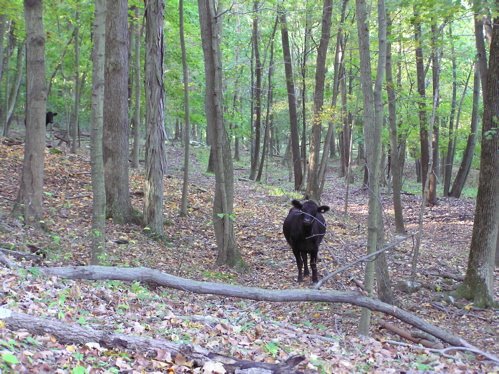
There's really nothing for them to eat, and it's full of white snakeroot (known locally as locoweed, which can kill them). Still, they looked neat, like big old black bears stepping softly through the trees. They came to check us out, and blow their fragrant breath at Chet. I was proud of the wee dogge. He trembled, but never barked or growled, and he sat quietly and observed the cattle, and left willingly when I asked.
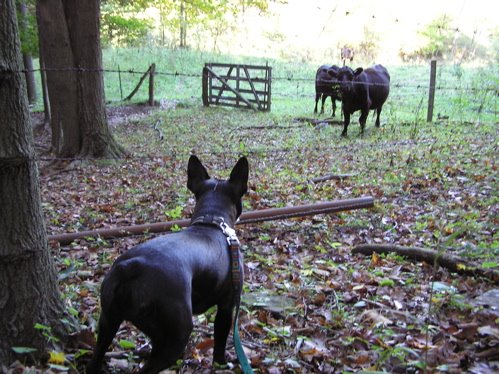
My goal is to cool him down about cattle, so he doesn't feel the need to head 'em up and move 'em out whenever he encounters them. Or to get his head caved in by a quick kick.From our border, we couldn't see the loggers, but the noise was overwhelming. As we turned to leave, a huge tree came down with the awful sound of hundreds of years of growing-- dying. I turned and raised my fists. RAPISTS!! I shouted, as loudly as I could. The only answer was the brup-brup ROWWWWWLLLL of the saw.
It's stupid and juvenile of me to rail against the time-honored southern Ohio way of making your land work for you. You wait until the timber gets some size, then you cut it down, taking all the biggest trees. Or maybe you completely clear it, and put cattle on it, to cut their zig-zagged trails deep into its flanks. The hillsides slump down, the mud chokes the streams, you sell the beef in the fall. That's how it works here, on all but a handful of farms where the farmers are sensitive to overgrazing and erosion. Like Jeff and Jay's, like Rusty's.
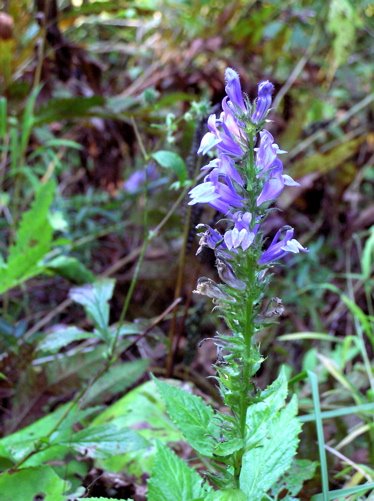
I work my land, too, in a much different way, and nobody calls me names. Well, at least not to my face. As I turned to go up the hill toward our old orchard, a big stand of great lobelia glimmered in a perched wetland.
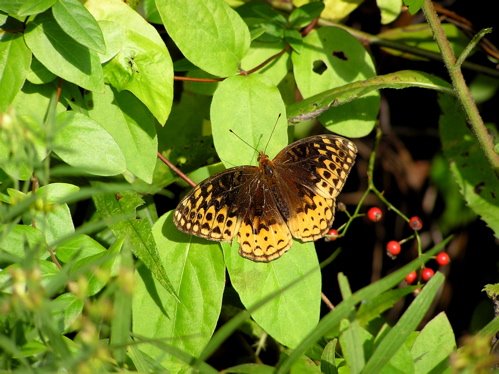
A female great spangled fritillary took the morning sun.
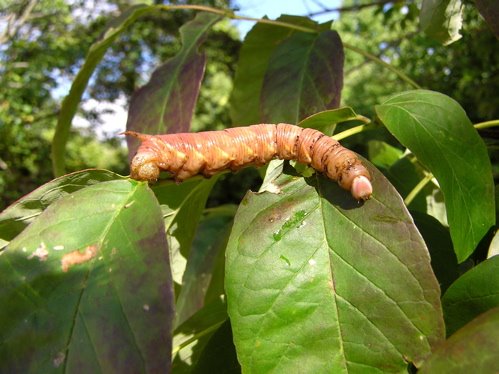
And a great ash sphinx cut holes in the leaves of a white ash.

13 Comments:
That post sounds good for NPR. I was right there with you when you raised your fist and shouted RAPISTS.
(And I don't think anyone calls you names behind your back...unless it's names like great lady, cool chick, awesome artist, fiery soul....etc.)
HUGS
1. It's here! Thank you, a new book is a treasure to be savored. My family of birth are inveterate readers aloud of snippets from tantalizing books...so I treated David and Rachel to same over dinner, they are patient with me, anyway.:)
2. David, who grew up on a dairy farm in the Champlain Valley, always regretted that the family Holsteins were allowed into the woods, the violets, trout lilies and vernal pools disappeared. They were a great treasure to a small boy.
3. The great spangled fritillary photo made me think, have you ever read Stephanie Tolan's "Surviving the Applewhites"? I bet Phoebe would like E.D. and I know you would. My middle schoolers just loved it, I must have read it 3 or 4 times myself.
Caroline in SD
We live in what USED to be the "Great Northwest Rainforest". When we first moved here we were very careful to not disturb the forest, cutting down NO trees. We built on the least desirable area (gravel pit) of the property. Now, 30 years later we are not alone. People have built "McMansions" all around us. They complain that the deer eat their carefully planted landscaping and that the woodpeckers are too loud in the morning. It might be time to move.
I can easily relate to your anger and frustration over logging and inappropriate farming practices.
We live in South-western Ontario which has excellent soil for cash crops.
Historically this area had mature woodlands and tall grass prairie. The forest cover has been reduced to 3% of the original. The majority of this is contained in Rondeau Park, which has approximately 98% of the remaining 3%. Doesn’t leave much for the rest of the county.
The municipal council raised the possibility of discussing a tree cutting by-law, just the possibility of discussing, not proposing a by-law.
Within days one third of the remaining wood lots had been clear cut and left to rot.
I appreciate that farmers, or anyone else, don’t want to be told what they can do with “their” land, but this is insane.
The farmers point is, they pay the same land tax on uncleared land as they do for productive land. There is no incentive to keep wood lots and good reason to “harvest:” the trees.
These same farmers then complain about changing weather patterns that bring drought or floods. Also in this area they put drainage tile every where so rain is shed from the land in torrents which in turn silts up all the streams.
Julie, you have a knack of pushing my buttons.
Thanks it keeps me mentally alert.
I've always been surprised to see my mother-in-law walk through the woods she owns in western Ohio assessing whether and which trees should be "harvested," she says. She doesn't need the money. She doesn't grow trees as crops. I think she thinks it is wasteful to risk that the tree will grow beyond maturity and rot and die. I always cringe but say nothing since she is my mother-in-law and I after all buy tree farm Christmas trees. Why does a tree growing in the wild seem so different to me than their planted counterparts? I don't know, but they do.
Linda, I think it's a way of looking at the land that you and I are not given to understand. We haven't been raised seeing a forest as a cash crop. I take a lot of satisfaction in making my living,such as it is, describing the forest, extracting wonder instead of wood.
Send me good teaching vibes...in two hours I speak to 118 eighth graders about nature writing!
Enthralling post. Logging is a big industry in PA as well, and every day on my way to work, I drive past a logged-last-year mountainside, and every day I just stare at the devastation and feel horrible. It looks like those pictures of the woods around Mt. St. Helens after the eruption in the 80s. It's sad to me how people can just rip the life right out of a forest and never even feel a twinge of conscience.
We do not cut trees, not even Christmas trees. I miss the great pine scent, but I feel better knowing our fake tree saved one tree's life.
Next year, roll down your window as you pass and listen for indigo buntings, common yellowthroats, eastern towhees, prairie warblers, and others. It will be popping with life when the new young growth gets the sun. I comfort myself by listening for American redstarts, hooded and Kentucky warblers at a plot that was cut two years ago. Nature rebounds. It's just so hard to see it exploited.
I just finished working in a 7th grade English class, writing paragraphs...boy, would we have loved to have you as part of our lesson this morning!
Caroline in South Dakota
I love how you say that you "extract wonder instead of wood" from the forest. Show the eight graders your book, and that may inspire them. Let them listen to your first story about the hummingbirds, and they'll hear respect for nature, humor, suspense, and information all in three minutes.
By the way, your book has been "faced out" at the Barnes and Noble in Berwyn, PA. And a copy just "happended" to be left sitting on one of the lounge area tables for someone to peruse. It will be put back tonight on the shelf, I'm sure (unless someone else buys it first!), but it's good to try . . .
Heather
Wayne, PA
At the risk of being banned from Zickworld, allow me to speak in defense of logging.
In my area, when a bunch of trees are cut down, they are gone FOREVER. In their place grow mcmansions, shopping malls, senior citizen housing. Until people no longer need to make a living and pay taxes, and we have unlimited funds for wilderness preserves, land will have to pay its way. And, let's not forget that we all use wood and wood products. Even the wonderful "Letters from Eden" stared life as a tree!
Forest management is a wonderful way to support greenspace. The key is to manage the forest with a trained, skilled, professional forester that is working for the landowner. A forester would help the landowner manage the woods for profit, wildlife, recreation, or whatever.
The problem, of course, is that most owners don't want to pay for professional advice and the guy with the chainsaw makes all the decisions. Loggers aren't known for worrying about dickey birds and the future growth and quality of the regeneration. That's what foresters are for.
Spoken like a professional.
;-)
Dear MojoMan,
Informed, enlightened comments are always welcome here. Mean-spirited comments are immediately deleted. You're right that a selectively cut piece of land is eminently more useful to wildlife than a paved one. This is a cycle, however painful it is to witness, and I have to accept it. And I do note that birdlife abounds in cutover timber. This post is just a howl of anger and loss, born of being surrounded on all sides by steep hills, repeatedly stripped of their timber, hopelessly overgrazed, and slumping into the nearest stream. The two pieces of land in question, as far as I can tell, are being selectively cut, and I hope there's a forester behind the plan. Thanks for your measured and always helpful comments, MM.
Post a Comment
<< Home