Eiders in Trouble
After seeing packs of female eiders swimming along without young when each one should have been followed by a brood, we were getting depressed. Productivity in Maine eiders is extremely low, while productivity in Maine gulls is extremely high. The predatory gulls are heavily subsidized by lobster fishing and fast-food dumpsters.
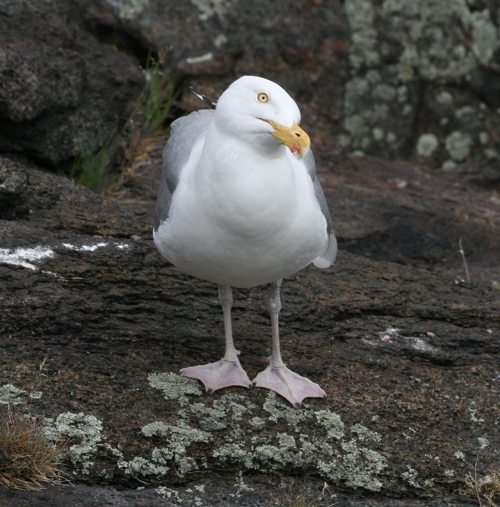 Nobody’s subsidizing the eiders. They’ve got to deal with more gulls than they’ve ever battled, and they’re essentially defenseless. What's a duck going to do when a great black-backed gull drops out of the sky and snatches her duckling? In an email today, Scott Weidensaul told me that the female eiders stick together and form a creche with their young. He wrote, " Sara Morris, in her years out on Appledore Island, once saw two hen eiders reach up at an attacking gull, each grab a wing, and slam the gull into the water like a stone, almost killing it." And yet even this spirited defense has little efficacy against so many gulls. A common eider productivity study by Kim Mawhinney in 1995 in the Bay of Fundy had 3000 ducklings hatched. Twelve of them made it to fledging age. Nearly all the rest went down the capacious gullets of gulls. Does that sound sustainable to you? Strenuous gull nest control efforts in 1996, including oiling gull eggs to prevent hatching, resulted in no decline in gull predation on the eiders: eight eider ducklings in the same population survived to fledge in 1996.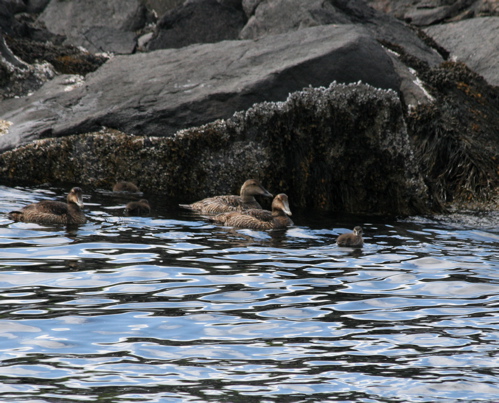
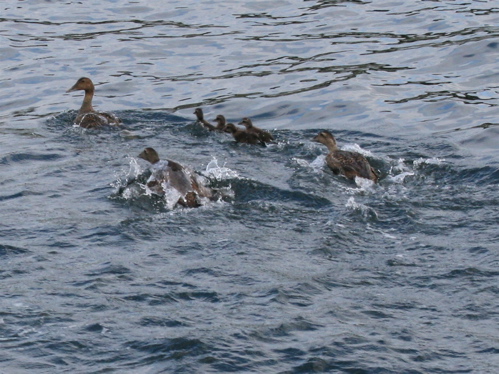
Finally, as we left Monhegan Island, we saw a couple of hen eider with young. Not many, but some. It’s interesting to watch the females when they’re swimming with flightless young. Normally, they’d fly when pressed by an approaching vessel. When they’ve got flightless ducklings in tow, they resort to “steaming,” paddling rapidly over the surface using their feet and wings. It’s this evasive behavior that named the flightless Falkland Island steamer ducks, creatures of rushing mountain stream habitats. The birds have no need to fly, and have lost the ability. These female eiders are steaming in solidarity with their as yet flightless young.
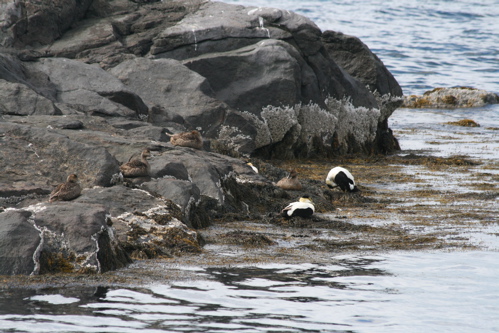
 Everywhere we went, we saw eiders loafing along the rocks, often with seals. I fought back a tinge of sadness even as I admired the drake’s beauty and the hens’ perfect rockweed brown camouflage, because I knew that the females should have been busy tending their young in the second week of June.
 What future does the common eider have in Maine, or the entire Atlantic? The same trends are occurring in the Pacific populations. Perhaps only aggressive gull control--eliminating adult gulls as well as their eggs-- could give the seaducks enough edge to enjoy some population growth. We can't take for granted that there will always be eiders. As the long-lived adults die off, what will replace them? We can be sure that, thanks to our landfills, fishing boats and dumpsters, there will always be gulls. Are we willing to lose eiders altogether? We must always be mindful of our impact on natural systems, and be ready to counterbalance the imbalance we unwittingly create.
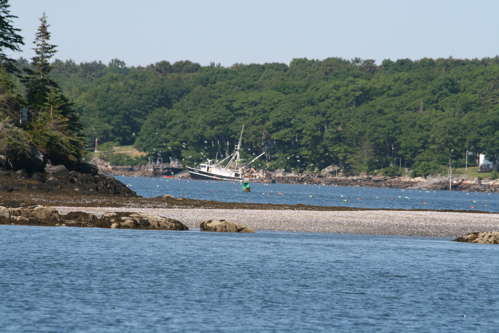 A fishing boat, swarmed with feeding gulls
Labels: common eider, eider population declines, gull predation on eiders

posted by Julie Zickefoose @ 8:26 PM







<< Home