The Wariest of Birds
Small technical detail: I'm suddenly being spammed at the rate of 100 messages every ten minutes, comments on archived blog posts, from "Anonymous." I've been forced to disallow anonymous comments on my blog, or risk losing email function. You will need to have a Google account to comment now. It's easy to sign up. If you're accustomed to commenting as Anonymous, just think up a random name for yourself, click "Other," and you should be good to go.
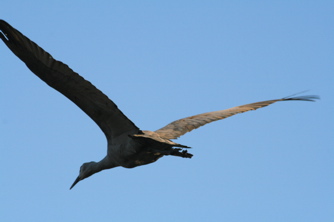
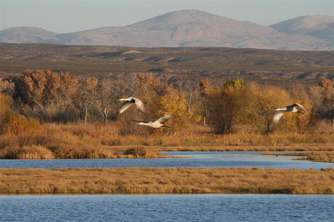
A rare close flyover. There's nothing quite like hearing the crane's sonorous purr right overhead, along with the rush of its huge slaty pinions. If you've never heard that call, please go to Susan's blog, where she has a wonderful video, with sound, of a huge crane flyover.
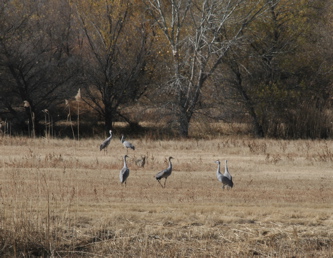
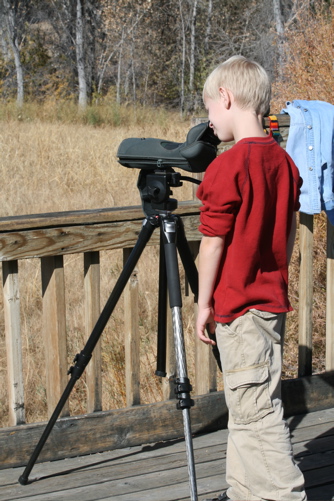
See the coyote, third from the left?The kids and I were watching a bunch of cranes out in a field when I noticed that their necks were unnaturally straight, and they had ceased feeding. "I'll bet there's a coyote around, kids!" And sure enough, a few pans of the scope revealed a pair of pointed ears in a patch of brush.
The coyotes were eating a carcass out in the field, and they really didn't pose much threat to the cranes, as long as the birds were aware of them. It's hard to sneak past a sandhill crane.
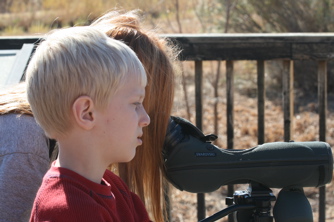
The kids were enthralled to watch a predator/prey interaction. Liam especially glued himself to the scope and fretted while Phoebe took a turn. "She's hogging it! She's had it for a hundred thousand million minutes!" We had the best time out on the refuge together. Once they settled into the slow but punctuated pace of nature watching, they were happy to while away the hours, peeking through the scope, playing with rocks and sticks and water while I looked for the next cool bird or animal to watch.
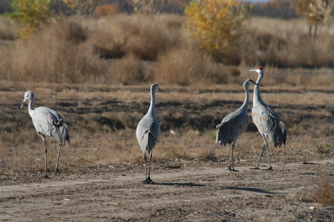
The cranes walk along the roads atop the dikes at Bosque, and they often seem to stand vehicles down, in no hurry to clear the way. It's so good to see them rule the place, when they're hunted for sport all along their flyway. Yes. Sandhill cranes are shot for sport (and occasionally for food) in every state they migrate through. There are seasons and bag limits on sandhill cranes all along their migratory route. If you don't believe me, just Google "Sandhill crane hunt." If you're sensitive, don't. Most birders, who will travel hundreds of miles to watch their migration gatherings, don't know that these "ancient birds" that they admire so much are targets for hunters, and are as shocked as I was to learn it. I think they need to know it, and I often bring it up when I'm among crane fans, even though it doesn't do much for my popularity. Talking about crane hunting in such circles has roughly the same effect as cutting a giant fart at a cocktail party.
I've got an article mostly written about it, but I'm pretty sure the usual outlets for my stuff won't be interested. Maybe it's one for the next book. The thought of bringing these long-lived, monogamous, family-oriented and highly intelligent birds down for sport or roasting makes me physically ill. But then a lot of what's done in the name of sport hunting makes me ill. I know I'm getting crankier as I get older, and more conservative about speaking out because it might just be crankiness at work. But there's something about sport hunting of sandhill cranes that strikes me as fundamentally, indefensibly, sickeningly wrong.
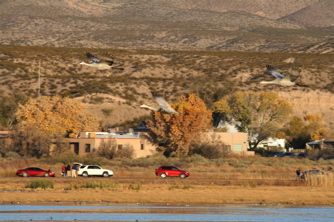
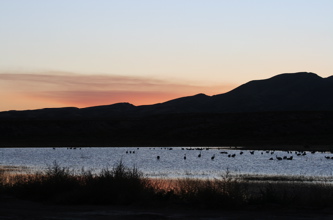
It's clear to me, if not to most state game and fish departments, that a sandhill crane is worth infinitely more alive than dead. (The same could be said of vanishing prairie chickens and sage grouse, both greatly admired by birders, hard as heck to find, and inexplicably, still hunted.)Just go to the Platte River in Nebraska in March if you don't think so. Crowd into a blind with dozens of other paying customers, and hear their awe and stunned gasps at the beauty of the flocks sleeping and rising off the river at dawn. Here, a trio flies past the visitor center at Bosque, past people who are paying just to admire them, and let them go on their way.
It does explain why sandhill cranes almost never allow a person within gunshot range; why they are the wariest of birds. Imagine how wonderful crane watching could be if they could relax around us, the way we relax around them.
Can we find it in our hearts to just let them be?
Labels: "sport" hunting, crane hunting, ecotourism, Sandhill cranes


41 Comments:
I'd certainly never heard anything about the hunting of Sandhill Cranes before -- thanks for bringing this to wider attention!!
...Ohhh, but you're wrong about one thing -- there is at least one bird warier than S. Cranes ;-)
I didn't know people hunted them either Julie. They are so very regal and beautiful.
This scenario always gets me confuddled.
We've evolved as humans in almost every area of our existence, and invented technology that can substitute for our involvement in many previously necessary activities. So, why is this most prehistoric activity appropriate in the 21st century?
I'd noticed the spam, Julie, since I had a couple of older posts marked to e-mail me directly. Sorry you've had to disable "Anonymous" comments to avoid the junk, but it shouldn't be too much of a hassle for your loyal fan base.
People hunt Sandhill Cranes? I never knew that. Why on earth would you want to? Are they so hungry that this is all they can find to eat? Do they stuff the cranes and hang them on the wall? I don't understnd the sport hunting mentality.
My Mom has photos of Sandhill Cranes in Florida where the birds walk around in peoples' yards and come to raid feeders, so there are some who have lost their fear of man.
I love, love, love Liam's rant: "She's had it for a hundred thousand million minutes!" No exaggeration here, right? Waiting your turn can be hard, Liam. Try standing in line for the scope behind a half dozen adults who never learned sharing.
~Kathi
My heart is sickened by the thought of any animal being brought down by an arrow or a bullet or buckshot or whatever the heck hunters use. The worst part of living "out in the country" is actually hearing those hunters shoot their weapons. I shudder to my core and run back inside the house.
There is nothing like the hyperbole of an 8 year old boy. :) The idea of hunting cranes is horrifying. Thanks for the amazing information and pictures, Julie.
Oh Lordy, shooting cranes. Friggin unbelievable. I thought sand hill cranes were a threatened species? I must be thinking of some other crane.
As wonderful as the film Winged Migration was, I still have not seen it as I was told there was a hunting scene and I just couldn't bear to watch that.
Hi Julie,
My theory is that "sport" hunting is all about dollars and cents--and the prices any state can charge for a hunting license--especially for a non-resident license.
Here in Minnesota, the powers that be have re-instated a prairie chicken season in selected zones. How stupid is that? (and I won't even get started on our mourning dove & crow seasons...)
They keep introducing wild turkeys farther and farther north to open up more hunting zones so they can sell more permits ($$$).
I purchase a hunting license in order to put meat in my freezer. Anything other than that I don't consider "sporting." (but that's just my opinion)
Ruthie, I was hoping to hear from you, since the hunting voice is underrepresented here. In answer to your prairie chicken observation: Really stupid. I cannot understand allowing hunts on these vanishing prairie grouse. Defensible, perhaps, only by the strength of tradition. And hey, they're "chickens." Sandhill crane hunting? Obscene.
I'm not a hunter but in the interest of playing the devil's advocate here, let me say I don't have a particular issue with hunting cranes per se. This isn't market hunting, and when properly managed the population is not affected in any real way. For any given state (Arizona for instance) less than 100 permits are given out for cranes with a bag limit of 2 birds per hunter. This is a miniscule amount when considering the entire population. Also, allowing for a yearly cull injects lots of much needed funds for wildlife conservation and management which on the whole is a good thing.
The perception that people are blowing cranes out of the sky willy-nilly is incorrect, it's no different that any game bird hunt. Introducing anthropomorphic adjectives like "regal" and "majestic" tends to cloud the issue with regard to modern wildlife management practices.
I think the real potential issue here is that a hunter could mistake a Whooping Crane for legal Sandhill Cranes. Such an action should be prosecuted to the greatest extent of the law.
Dear N8,
You raise excellent points. I had considered pointing out the potential of incidental kill of whooping cranes and great blue herons, but decided to leave the post as an aesthetic judgement against hunting, which it certainly is.
I question the use of the word "cull," which implies that a hunter would take a weak or sick individual. Someone trying to shoot a sandhill crane would shoot any bird he was close enough to hit.
You're right. A hundred or so birds taken in Arizona might have no effect on the overall population, so why not shoot them? The point of this post was to raise that question. And I believe it's perfectly valid to object to a hunt on aesthetic grounds. I also feel that it's a shame that birds which are so sought after and enjoyable to watch as they interact, dance, and feed should be rendered so wary as to be visible only through high-powered optics (Florida birds excepted). The vast majority of people enjoying cranes are enjoying them without killing them. I'd submit that that majority would strenuously object to the shooting of even an insignificant number of cranes, purely on aesthetic and humane grounds.
There are a number of issues that I feel deserve more than a clinical look. For me, the issue isn't whether there are enough cranes to kill some every year. The issue is whether it makes sense to kill a bird that is highly valued in ecotourism, that is highly intelligent, long-lived, monogamous, has a low reproductive rate, and is simply beautiful. There are lots and lots of herons and egrets, but we don't kill them any more, thanks to the efforts of the National Audubon Society. Could heron and egret populations support hunting? Sure. But should we kill any bird whose populations can support hunting? Why not shoot kestrels and red-tailed hawks, if that's the only criterion? I believe the sandhill crane deserves protection as well.
Birdwatchers, ecotourists, go out to your post office, or order a duck stamp online at www.usps.com. Put your money where your mouth is, and don't let hunters try to justify shooting sandhill cranes because they paid for preservation of their habitat all by themselves.
Phew. That was fun. Thanks for letting me think about this in more depth.Good thing to do on a snowy day.
Julie you bring up some very compelling issues. A was fervently against hunting of any kind and also extremely naive as to what sources really funded conservation areas. I moved back to Oklahoma this year and started birding for the first time. The amount of species found in our refuges and conservation areas, due to the Central Flyway, is overwhelming. I've learned, in this state for certain, without the hunters and their pricey permits - much of this beloved land and exquisite habitat would be filled-in, plowed under and growing wheat instead of wood storks, roseate spoonbills, bald eagles, black-capped vireos and the other hundreds of species that make a temporary home here.
I long ago stopped trying to figure out the sport hunting mentality -- it makes me shudder at every thought. But as I walk out among fertile, rich habitat - saved from the plow by sport hunters -- I am learning to make my peace.
I think most people would be surprised how much of the protected land they love and enjoy is funded by hunting permits. And in most cases, as n8 said, these permits are managed by conservationists, biologists and wildlife managers with the best interest of the species and the protected land at heart.
At least in Oklahoma you can't hunt the prairie chicken -- which is a good thing. Although their demise is coming swiftly at the hands of the allegedly "green" wind-energy industry. That's certainly another topic for later discussion.
Woo, yeah, don't get me started on windpower. It's a sore spot here in the land of Dolly Sods. Go OK on the prairie chicken hunting!
Julie,
I tend to agree with you, I'm not particularly advocating crane hunting just trying to put it in context. Wildlife and game managers tend to look at birds as populations and not individuals which makes hunting easier to understand.
I absolutely agree with the sentiment though, that birders and other non-hunters should get more credit for habitat preservation. The Pittman-Robertson Act was really influential to that end, in which a tax is levied against sportsmen for purchases of guns, ammo, etc. The money goes to habitat preservation. I'd be totally for something similar enacted for purchases of binoculars, scopes, field guides and things like that. That way we would get the recognition deserved.
The Nature Conservancy here does a good job of buying adjoining land and conservation easements around already protected property. And their land is hunter, windmill, and atv free. In addition to the duck stamp, support the Nature Conservancy and ask that your donations be earmarked for local conservation projects.
This post has been removed by the author.
I've thought long and hard about this posting.
Where I grew up, people hunted to feed their families. In the 1970s, hunting was an absolute necessity for many families. It still is. In that respect, I don’t think it is an inappropriate prehistoric activity. But I do think it is inappropriate when we hunt endangered animals, when we hunt (or fish) them to death in pursuit of other “more valuable” species, or when we want a trophy rack, vanity pelt, or stupid thrill, and leave their bodies to rot on the ground.
A few years ago, an Anishnabeque (Ojibway woman) elder explained to me the importance of being respectful to the animals whose lives you take; she said that a true and honourable hunter will look that animal in the eye and will know exactly what he or she is taking, will offer thanks, and make repentance for having taken that life. S/he will honour that animal by using every part of an animal possible, returning what is left to the earth so that it can renew life.
Julie, I always appreciate the way you are able to open issues such as these with passion, intelligence, and respect.
It really isn’t all about the dog!
Well, I couldn't kill anything..I save the lives of stranded earthworms...I couldn't bear to (directly)kill the cockroaches in my apartment in the city. I couldn't kill an English House Sparrow, though I am sorely tempted and have a standing offer of a pellet gun to use to get the job done.
However, I have no problem with hunting. License fees pay for conservation programs that are constantly being cut by the administration. Deer are pretty, too.
Endangered Whooping Cranes not only could be shot by Sandhill Crane hunters, they have been, two in Kansas in 2004 ! Others have been shot by Snow Goose hunters, though not in the last few years. Just deplorable ! These were whoopers from the Wood Buffalo-Aransas NWR wild flock, currently about 250 birds. These birds migrate between NW Canada and Texas each year.
Great post, Julie. I agree with LittleOrangeGuy. Those of us who admire you take in so much information and we are enlightened. It's not all about the dog.
What a great comment-discussion you've triggered, offering a forum for an objective all-points-considered exchange. I'm always impressed at how you straddle the line between emotionality and pure scientific observation, finding beauty and meaning in both perspectives.
Your post triggered some daddy-hunting memories for me, and I ended up posting about it--though not as eloquently as you! Check it out if you have a minute sometime.
Hi Julie,
It sounds as if your New Mexico visit was magical, at least on the surface. Like most tourist attractions, it pays to look beneath the surface, and your post wonderfully represents bot the majesty and the tragedy of the Sandhill Crane. I loved the text and the photos. I'm just sorry that I didn't get to meet you when you were here.
Cheers,
Gail
Well, before the Whooping Crane experiment at Bosque del Apache failed, anyone who hunted Snow Geese or Sandhills in the Middle Rio Grande Valley wildlife areas had to attend a class and pass a test on bird identification. Since the Whoopers failed to breed and have aged out of the population, the class is no longer required. In the twenty some years the Whooper experiment went on, I recall one that was shot by a hunter and that individual was prosecuted.
Crane permits in the area described in this post are closely controlled. Other areas, such as Easter NM and the TX Panhandle, have bag limits but do not limit permits (limited permits are distributed by lottery). The number of permits in that area has gone down, no doubt in response to fluctuations in crane numbers.
"The thought of bringing these long-lived, monogamous, family-oriented and highly intelligent birds down for sport or roasting makes me physically ill."
No question cranes are beautiful and interesting birds. As far as "sport" goes, it is not only illegal but against the ethics and traditions of hunting to leave meat in the field. Since they eat a lot of grain, Sandhill Crane is generally more mild than goose, though a similarly dark meat. Since you find hunting "indefensible", I won't argue but echo t.r.'s point and say that you wouldn't have had a refuge to go to, nor likely any birds to see, but for the interest of hunters in the ducks, geese, and cranes the lobbied, advocated, and raised money for. Probably the best thing that can happen for Prairie Chickens is a hunting season, as that keeps the most effective wildlife advocacy group this country has ever seen (in terms of money, actual boots on the ground, and political influence) aware of the species and working on its welfare.
Great point about buying a duck stamp and a question off topic- how many of you all wrote your congressperson this past year when they were looking at cutting the CRP way back? I hope the answer is "all"
Hi Julie,
We may both regret my posting, and I apologize in advance if that proves true!
I enjoyed your sincere piece on the Sandhills and the prospect (or the horror) of hunting them. I am a hunter---not of cranes, but of other birds I'm sure we both would agree are beautiful and wonderful and worth protecting.
It's a conundrum, the hunter's worldview, and an old one. Michael Pollan called it "The Omnivore’s Dilemma," which expands the implication to all of us---even those who choose not to hunt or eat meat.
My aim here is not a defense of hunting. But I would like to comment on the use of the term "sport hunting," which, like you, I also find offensive and difficult to reconcile.
A few years ago, the USF&WS proposed a review on the "sport hunting of migratory birds," which included an opportunity for public comment. My comment (as a hunter of migratory birds) was obviously in support of continuing the Service's hugely successful wildfowl conservation programs, which are funded in large part by hunting permit fees.
But I took objection to the casual use of the term "sport hunting," which I view as implying that the activity has no practical purpose or intrinsic value and is thus merely an exercise in cruelty.
From the comments posted here, I think a lot of folks feel the same way.
It may be that some hunters kill only for sport, meaning they have no intention of eating the animal, and that, moreover, they view killing it only a test and proof of their skill. Large white men in safari hats standing over dead lions come to mind.
But believe it or not, such people are rare. Whether they should properly be called “hunters” or “shooters” is a point of some debate in hunting circles; the fact is, most people who hunt wild animals eat them. Securing food is a necessary component of hunting for most Americans, even in this “time of plenty,” when plastic wrapped meat can be purchased from Wal-Mart.
I said this was no defense of hunting, but I suppose it is a defense of eating animals, generally. If you choose to eat animals, then you must choose either to kill them yourself or pay someone else to do it for you.
On a small scale, paying someone else to do the killing is a practical and long-held practice among people in small communities everywhere. It is no cruelty or moral cop-out to let a small local farmer provide your meat.
But to buy meat from huge corporate supermarkets is to buy meat from animals almost certainly raised in horrifying squalor and crushing density and killed with indifference to every value except profit.
Yet I do this, and most Americans do too. It is not particularly pleasurable to think about.
In high contrast (to me at least), is my seasonal hunting for meat. An animal still dies to feed me and my family, but it is not one raised in a pile of manure, penned tight against a thousand others and pumped full of drugs so that it can die young in a factory rather than even sooner from stress and disease.
Avoiding the support of such horror to do, instead, only what the cats and hawks and coyotes do for a living is a pleasure and an honor.
As long as I choose to eat meat, I will choose to hunt (clean, and cook) as much of it myself as I can.
I appreciate your attention and patience with my statement here. And I thank you for the opportunity to comment.
Dear Matt,
Thank you for your thoughtful post. I want to hear from people who hunt. I want to understand why sandhill cranes are hunted. I'd love to think that every one that gets shot gets eaten, even though I doubt that is true. I agree that my use of the term "sport hunting" was loose, and doubtless offensive to responsible hunters everywhere, and I apologize for that. I checked out some outfitter websites that glorified what seemed to me to be recreational shooting of cranes, and I got mad. Reason flies out the window when I'm mad.
I hope you appreciate that, as a carnivore, I can't and won't criticize hunting for food. I admire people who can kill, clean and prepare their own food. I've been inside hundreds of dead birds and animals in preparing specimens, eaten lots of venison given to me by hunter friends. I buy local, humanely raised meat as well as the Styro-packaged stuff. I completley agree with you on those points (and have a series of sustainable farming posts now) No problem there. The point I'm trying to make is that I don't understand why sandhill cranes should be subjected to hunting, when herons and egrets aren't. Why not shoot roseate spoonbills? Why not wood storks? They're coming back. There are probably enough of them to support shooting a few every year. That's my point. I don't get it. Is it because sandhill cranes happen to taste good? Is it because there are so many of them?
My main point, though, is that I think that sandhill cranes are worth much more alive than dead, as ecotourism attractions. I think it's a shame that hunting by a very small number of permit holders makes the birds so wary that the millions of people who just like to watch them--a non-consumptive but economically valuable use of the resource-- have to watch them at great distances, or from blinds in the pre-dawn darkness. There's something about that situation that doesn't seem right to me.
I have a feeling you and I would get along just fine should we meet and talk. We share a great deal, much more than we disagree on. You'd be a blast in the field, I'm sure. And I very much appreciate the respect you show in your post, catching more flies with honey than vinegar. I'll admit that I'm brimful of vinegar on this topic. I'd really like to entertain a persuasive argument for shooting sandhill cranes in this forum. So, as they say, hit me with your best shot!
Julie that was a wonderful reply. Thank you.
I would like to rise to your challenge and offer a defense of Sandhill cranes as proper quarry for hunters, except that I have very little personal experience with this species as game.
Here is what I know: On the high plains of the Texas Panhandle, a flock of cranes can be seen and heard from miles away. They are a stunning sight (writer Steve Bodio calls them "flying crucifixes"*) and produce a sound, as you know, like almost nothing else on earth. It is haunting.
Upright and walking on the ground, the cranes are easily anthropomorphized. This was especially true of those I knew in Central Florida that walked in small groups across suburban lawns, tall as ten year old children. In a huge flock on a grain field, they seem more like a crowd of noisy old men.
Why shoot them? The first answer must be for food, and they are GOOD eating! I kid you not and would never joke about good food.
As others mentioned, Sandhill cranes eat grain (at least in winter on the western plains) and their breast meat is dark and rich and tasty as premium beef or elk. I've eaten it grilled, which one would expect to dry out any wild bird meat, and yet found it to be juicy and flavorful and indistinguishable in texture from beef.
The other, superficially similar birds you mention (storks and herons) are actually unrelated waders and eaters of fish and other aquatic small animals. I don't have a clue how they might taste, but I gather it might be "fishy!" At least, there is a long history of hunting cranes for food, but no such comparable tradition of hunting herons for the pot. I think that tells us something.
I am not sure how to address your point that human hunting pressure makes cranes wary and difficult to view. I wonder if that could be the only answer?
Certainly, in Florida the cranes I saw were tame and faced no threat from suburban homeowners. You could view them from quite close.
But on the high plains, humans are the least of the Sandhills’ worries. Coyotes, bobcats, eagles and the larger hawks all eat cranes regularly. Cranes flock and feed together, I would hazard to guess, as a defensive measure as much as for the company. If cranes are wary in the wild, they probably have good reason to be. Remember, they taste GOOD.
I hope someone else with real experience hunting cranes can weigh in here, but I don't expect that's likely. They are not a popular quarry (relative to waterfowl or deer) and I suspect are hunted regularly (and respectfully) by only a few specialists. The others, whom you saw catered to on the outfitters' websites, probably would not be hunting cranes without such special catering.
Probably they could not get themselves close enough to try.
* http://stephenbodio.blogspot.com/2006/06/ten-birds-part-1.html
Well, I'm no Mullenix but I hunt (I've hunted cranes) so I'll throw a couple of thoughts out.
You write-
"I think it's a shame that hunting by a very small number of permit holders makes the birds so wary that the millions of people who just like to watch them--a non-consumptive but economically valuable use of the resource-- have to watch them at great distances, or from blinds in the pre-dawn darkness."
I'll approach from a bit of a tangent. First, wonderful as the National Parks are for viewing wildlife, there is something not real about watching animals where they are indifferent to humans. It is a thrill, but a large part of that thrill comes for many of us because of the rarity of watching a big mule deer buck or a band of elk go about their business. Normally, it takes skill and luck to get such a treat. In a park, though, it isn't natural, not normal. Throughout history, humans have been active parts of the ecosystem and animals have reacted to us. If we weren't predators, why do we get such a thrill out of watching animals? Watching animals in a zoo is unsatisfying as an adult because it is too artificial. I wouldn't want hunting in National Parks, absent some sort of emergency cull. Nonetheless, to me viewing animals in a Park does not really convey a true sense of how wary and special they really are. I get a kick out of it, but an elk fifty feet from the road in Rocky Mountain National Park is not the thrill as an elk in an aspen grove on the Uncompahgre Plateau.
I'm kind of surprised that you find cranes so wary. I watch them nearly every weekend from the first of November to the end of January while on the river only a few of miles from where you took those lovely photos. They typically fly low and, while they will flare if they notice a human, they aren't particularly observant. They'll usually let you walk up to within about fifty yards and, if you go up the the Bernardo Waterfowl Management Area a couple of miles north, you can drive to within twenty yards of them. I find snow geese much more wary of humans. One hunter I know hunted cranes once, then never put in for another permit because "they're kind of dumb" in his opinion.
Addressing your thought regarding birdwatchers and the economic value of eco-tourism, I don't think that it is as great as you do. I recently returned from a hunt in the Panhandle of Texas, near a little town called Tulia, between Amarillo and Lubbock. 5,000 people in town. The motel we stayed in had perhaps eight vehicles parked in front, of which five belonged to bird hunters, some of whom were hunting cranes. I would guess that most birders would be happy to either see cranes near their home (heck, I am) or might travel to a refuge such as Bosque del Apache to observe them. That travel helps Socorro and maybe some of the outlying towns if folks travel, as you did, to Magdalena or like places. However, it doesn't bring any money to eastern NM, the southern Rio Grande Valley, the Gulf Coast Prairie (think Eagle Lake, Tx) or the Panhandle where significant numbers of Sandhill Cranes winter. Hunting puts people in motels and cafes and some money in landowner's pockets, giving all those folks a concrete reason to be concerned with the welfare of cranes. In contrast, as long as say 5 thousand cranes wintered at the Bosque and the Festival of Cranes was held each year and there were a few birds at Matagorda, the economic impact from birders would be about the same. For that matter, cranes are most likely to be hunted by waterfowlers and our big conservation group is Ducks Unlimited. Is there any organization for birders that can come close to the $162 million raised by that organization, of which over 80% went to conservation on nearly twelve million acres in three countries!
I'm not knocking other organizations, every dollar and half acre of habitat helps, but I really question the economic impact of birding as opposed to hunting. That said, I welcome every bit of habitat preserved or improved by birdwatchers- in love of birds, animals, and wild bits we have common cause.
At to why we don't hunt spoonbills or wood storks, I'd guess that they don't taste good and that interest in doing so is too low to defray the cost of permitting and monitoring the hunt. Which creatures are considered game or food sources in different areas or cultures is an interesting whole other topic.
Last, I apologize if my previous post came across as a bit strident. I completely understand the topic causing you to feel "brimful of vinegar". I feel the same way, myself, coming from the other side. Initially reading your post and the comments, I was struck by two thoughts- these sound like interesting people who I'd have much common cause with and yikes(!), these folks are from Pluto when it comes to views on hunting- they would like to lobby to take a plentiful game bird off the list!
Loving this. Since the vast majority of readers have moved on to my usual fare of cute dogs and goat cheese, it's nice to be able to take things into a little more detail. Thank you, Matt and mdmnm, for confirming my suspicion that sandhill cranes taste good. I needed to get that from the hunters' mouths. Like all writers, I'm gathering information here. Like all bloggers, I'm making assertions that may or may not be borne out by fact. It's a luxury I don't have in writing for magazines or books, which may be why blogging is more fun. And why I'm doing this instead of writing about chimney swift feces (my pursuit for the last day and a half).
I will confess to being a bit weary of being beat over the head by Ducks Unlimited's roaring success. Of being told that I'd have no place to watch birds if it weren't for hunters. I'm tired of getting mailings from Pheasants and Quail Forever, boasting about their millions of members. I don't understand why hunting organizations garner such strong support, when a terrific bird magazine like Bird Watcher's Digest has to scrape for every subscriber dollar they get. Why birdwatchers and nature lovers are so darn passive, and so darn cheap. I've been trying to sell art and books to them since 1976. They are.
I envy hunters their sense of fraternity and their pride in protecting habitat. I wish hikers and birders and passive enjoyers of the out of doors could be one one-hundredth so dedicated, so willing to write a check for what they cherish, so clear about the connection between land preservation and the preservation of their hobby. But they aren't. It's more of a cerebral, surreal thing for us...we're just glad there's "wilderness" out there "somewhere." They don't seem to realize that they could make a difference if they just cared a little more, and were willing to let a few dollars slip through their fingers for conservation.
I've enjoyed getting you guys in the mix. I need your help to poke my side into some kind of action. I want these nice folks to know more about the birds and animals they love, and I want them to think about things they'd never think about otherwise. Every once in awhile, you do need to fart at the cocktail party.
I'm tickled at having smoked a couple of articulate, thinking predators out of the thousands of nice folks who read this blog.I won't be joining you for roast crane at the Thanksgiving table any time soon, but I appreciate your thoughts, and your willingness to lay them out in a respectful way. I don't think it's fair to classify people who are appalled at crane hunting as noodniks from Pluto, any more than it's fair to characterize crane hunters as barbaric goons--the gut reaction each of us has to the other, the one we have to fight off if we're to communicate. There's a lot of emotion on either side of the barbed wire that separates us, and there's precious little real information or empathy. Thanks for helping me closer to understanding why people hunt cranes.
Yeah, DU, QU, PU, and the rest aren't shy about publicizing their efforts and I can see where it would get old.
As far as the "from Pluto" comment, I sometimes forget how opposed some people, even outdoors people, are to hunting. At social gatherings, folks just kind of smile and fade away when the subject of hunting comes up, for the most part. Much like I do when faced with a conversation of the joys of veganism. This was a good reminder for me.
I should have mentioned, I found my way here by way of a link from writer/conservationist/hunter Henry Chappell's Home Range.
Hi Julie,
We may have spooled this out as far as we can in one day. But let me say I agree we have much in common---a glance at your profile alone finds some of my favorite music and books (I love Dillard)!
So maybe there is room to slip past the barbed wire after all. I hope so.
Incidentally, I was pointed to your post by mention at writer Henry Chappell's blog. Henry has been enjoying your pieces for some time. And he hunts birds. :-)
* http://byhenrychappell.blogspot.com
I have never hunted cranes, but I have and do hunt ducks, geese, and turkey.
I suspect that the commenter is correct who suggests that assigning such adjectives as "majestic" to them is merely a reflection of their profile -- the way they seem more bipedal, somehow, than a duck does.
And yet I think of wild ducks as incredibly gutsy critters that do get me up before dawn and out into a swamp to see them -- and they do taste excellent.
I trust Matt Mullenix that grain-fed cranes are equally tasty. We have been eating them for 30,000 years or so, I suspect.
Crane hunting is a very thought-provoking topic and a practice that I find always surprises people. I have hunted some waterfowl in the past, but I could never get myself to hunt cranes. Their human-like stature and the precarious population status of most species adds up to too much of a stigma for me. I tried crane prepared by a coworker once and it tasted as good as any wild game, but not good enough to make me want to shoot it. I am also puzzled by the hunting of mourning doves, Wilson's snipe, and woodcock, for which the amount of meat harvested does not do not seem worth the effort or worth cost to their populations. The only birds I would feel goos about hunting these days are mallards, some Canada goose populations, and exotic game birds.
Sandhill cranes are not hunted in every state they migrate. Nebrasks for instance does not allowing hunting. Hunting has and always will be an important part of wildlife management. The amount of hunters who actually hunt Sandhills cranes is minimal. Money is not a factor for states to offer hunting of cranes.
This post has been removed by the author.
winning roulette systems | free roulette systems | roulette strategies | how to play roulette | online roulette | how to win at roulette | roulette | free roulette | tips for roulette | roulette system
wow goldwow goldaoc goldwow gold cheap wow gold to our loyal reliable customers.
world of warcraft goldbuy wow goldcheap wow goldwow power levelingwow powerlevelingwow levelingworld of warcraft goldbuy wow goldcheap wow goldwow power levelingwow powerlevelingbuy wow goldcheap wow goldwow power levelingwow powerlevelingEverQuest 2 goldeq2 platrunescape goldrunescape moneyEverQuest 2 goldeq2 platLOTRO GoldLOTR Goldlord of the ring goldMaple Story MesosMaple Story mesomaplestory Mesosmaplestory Mesosilkroad online goldLineage 1 adenaGranado Espada goldSilkroad goldbuy silkroad goldflyff penyabuy flyff goldflyff moneyfinal fantasy xi gilffxi gilEverQuest platbuy eq goldEverQuest goldeq plateq goldAge of Conan goldage of conan power levelingEverQuest platbuy eq goldEverQuest goldeq plateq goldrunescape goldrunescape moneyEverQuest 2 plateq2 platCity of Heroes influencecoh influenceCity of Villains infamyCOV infamylineage 1 adenalineage adenamaple Story mesosmaplestory mesosmaplestory mesoMaple Story mesopotbs doubloonragnarok zenyro zenyrappelz rupeerappelz goldstar wars galaxies creditsswg creditssilkroad goldsilk road goldsword of the new world vistales of pirates goldtibia moneyvanguard goldage of conan goldage of conan power levelingage of conan goldage of conan power levelingage of conan goldage of conan power levelingage of conan goldage of conan power levelingage of conan goldage of conan power levelingage of conan goldage of conan power levelingaoc goldaoc goldaoc goldaoc goldaoc power levelingaoc leveling
age of conan power levelingAge of Conan goldaoc power leveling
WoW Gold,WoW Gold,WoW Gold,WoW Gold,WoW Gold,WoW Gold,WoW Gold,WoW Gold,WoW Gold
One of the most fast wow gold popular aspects of fast safe wow gold any MMOG is the trade-skill safe wow gold system. Almost all MMOGs have safe world of warcraft gold professions and trade skills Buy Wow Gold that players can skill Cheap WoW Gold up to help Cheap WoW Gold create a wow gold for sale robust, fully independent cheapest wow gold player-based sell wow gold economy. This wow gold sale type of game play adds gold for wow,gold in wow atmosphere, immersion buy cheap wow gold and robustness to wow gold us the gold wow world that would otherwise not exist. In World of Warcraft, there are conan gold,buy conan gold,cheap conan gold,cheapest conan gold numerous full and secondary professions, all age of conan gold with their own unique advantages buy age of conan gold,cheap age of conan gold,cheapest age of conan gold and aoc gold benefits. A player may only select buy aoc gold,cheap aoc gold,cheapest aoc goldfrom two full professions and any number of secondary world of warcraft gold professions.
Some profession combinations buy world of warcraft gold make sense, as cheap world of warcraft gold they compliment each cheapest world of warcraft gold other quite nicely: Alchemy sell world of warcraft gold and Herbalist,world of warcraft gold sale,Mining and Discount WoW Gold Blacksmith and Skinning and wow power leveling,wow powerleveling Leatherworking. Others can power leveling,powerleveling be combined with virtually any other and wow powerleveling still be complimentary, like wow power leveling Tailoring and power level Engineering. With powerlevel so many different combinations cheap powerleveling it can be cheap power leveling difficult to know wow powerlevel which is the right ones to wow power level pick for your powerleveling 60 70 character. Secondary powerleveling 1 70,power leveling 60 70 and power leveling 1 70 professions are extremely useful as well; cooking allows you to make special foods that give you temporary rs powerleveling buffs, first aid is rs power leveling useful for post-combat healing and lineage 2 powerleveling in large raids l2 power leveling and fishing is an excellent source of ffxi gil rare ingredients for cheap ffxi gil special items and potions. All buy cheap ffxi gil professions take final fantasy 11 gil time to level up as well, requiring maple story mesos a player to spend maple story meso hours roaming through the maplestory mesos wilderness collecting ore, herbs or killing foes maplestory meso for cloth pieces and rare buy maple story mesos ingredient drops.
Leveling up your buy maplestory mesos professions can be cheap maple story mesos,cheap maplestory mesos frustrating eve isk and time consuming, yet buy eve isk,eve online isk the rewards for reaching maximum skill in these buy eve isk,cheap eve isk professions is undeniable. There is lots of lineage 2 adena money to be made in the player buy lineage 2 adena economy if you have buy lineage2 adena the time to cheap lineage2 adena maintain your skills cheap lineage 2 adena and keep farming cheapest lineage 2 adena for l2 adena materials. Even lineage2 adena the raw buy l2 adena components themselves can sell cheap l2 adena for a lot on cheapest l2 adena the Auction eq plat House. This is where we can help you raise your profession skills. With our eq2 gold help, we can get your eq2 plat profession skills up to 300 and everquest 2 gold farm materials and components for you to sell or work up your crafting professions. With our help, your character won't just be everquest 2 plat a devastating combat machine, but also a skilled tradesman, creating rare and expensive items to be sold in the player drive economy.
不動産 東京
不動産
ウィークリーマンション
バイアグラ
RAID復旧
データ復元
データ復旧
テレマーケティング
データ復旧
手 汗
手掌多汗症
メタボ対策
不動産担保ローン
株式投資
ショッピング枠 現金化
バイアグラ
カラコン
デリヘル
キャッシング
海外推广
国际推广
网络营销
网络推广
toefl
ECサイト構築
マンションリフォーム
ウェディングドレス
太陽光発電
害虫駆除
治験
ウィークリーマンション
介護
葬儀 東京
看護師
横浜中華街
アメリカ ビザ
ダイビング
結婚指輪
キャッシング
マッスルトレーナー
結婚式 演出
吉原 ソープ
永代供養
会社設立
転職
メル友
データ復旧
釣具
釣り
ウェディングドレス
ウェディング
不動産
賃貸
横浜 賃貸
<< Home