Tuesday, May 06, 2008

Turkey Days


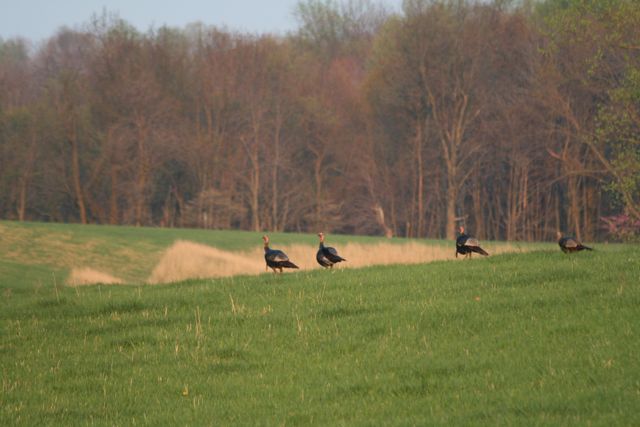
When we go out on these balmy soft spring mornings, it’s not long before the air is shattered by the explosive gobble of a wild turkey. Something about this call makes me laugh; it’s more like a sneezing fit than a song. Turkeys are doing well around here, despite coyotes and great horned owls, raccoons, opossums and free-roaming cats. They’re doing so well that wherever they appear, ruffed grouse seem to vanish. I’ve seen the changeover on our own land. Granted, I may not have the whole story; other factors such as a maturing forest could have more to do with grouse disappearance than does competition with turkeys. But if you think about it, turkeys and grouse eat essentially the same thing, but turkeys have a much higher reach for buds and seeds than do grouse. I don’t know. It’s a theory, like almost everything else in natural history.

I’d rather feed turkeys than hunt them; I’d rather watch them court than call them in to shoot them. I do have a certain admiration for anyone who can get close enough to a turkey in the woods to shoot it, though, because as a deer hunting friend once said, “Deer are deaf, dumb and blind compared to turkey.” Turkeys don’t miss much.
You have to go out before dawn and camo up and be still, and you have to be good with calls.

I was checking bluebird boxes along a country road near our house when I saw my pals, the Warren boys, in a red pickup ahead. Like turkeys, the Warren boys don’t miss much. They recognized my car in the their rear view mirror, pulled over and got out. Jeff pulled out his crow call and cawed to me. I cawed back. That’s how we make contact in Whipple. They were dressed in camouflage and grinning ear to ear. “Got a 20-pounder this morning,” Jeff drawled. “Ooh, can I see it?” I always like to see wild things up close, even if they’re dead.

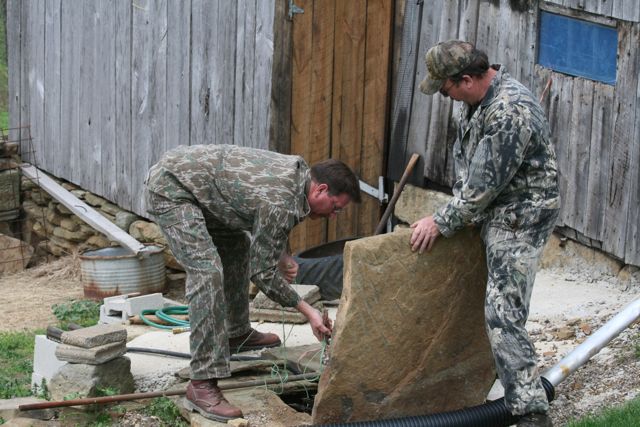
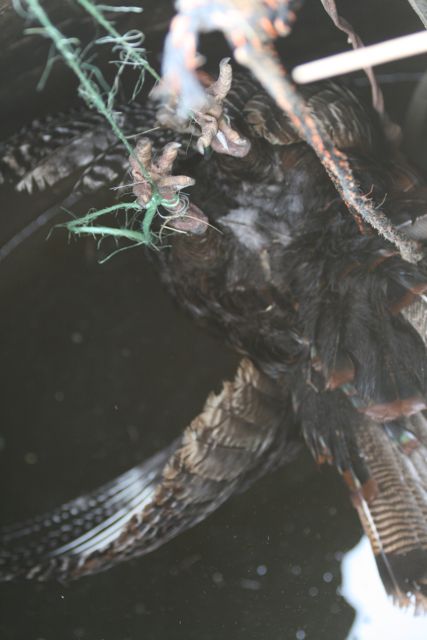
“We put him in the cistern to keep him cool.” So we drove up to the barn and the Warren boys grunted a big slab of sandstone to the side, uncovering a magnificent shallow cistern half-full of water. Dangling just over the surface was the turkey, relieved of his innards. There was something spooky, mysterious and ooky, about the giant bird slowly twirling over the cold murky water.
They hauled him up and laid him on the grass for me to admire. Jeff showed me his short, straight spurs, suggesting that he was in his second spring. I showed the Warrens the brown vermiculation on his tertials, suggesting the same thing to me. We traded bits of information.
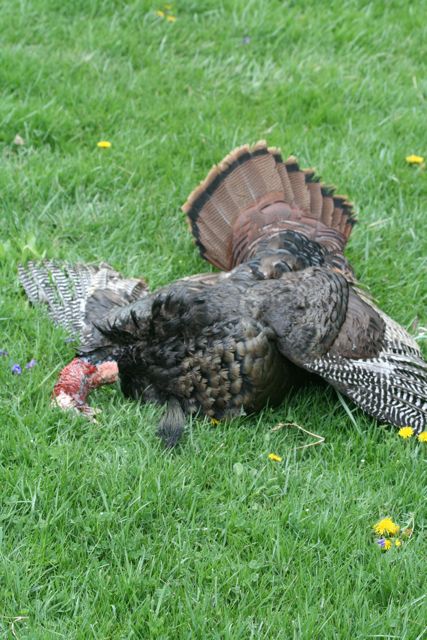
“Ever feel the beard?” Jay asked, and I was intrigued to find it just as stiff and tough as horsehair, stronger even, perhaps. The feathers are without barbules, black and wiry. Now it was my turn to tell them something. “Recent research suggests that the beard isn’t just decoration. It may be a sensory organ that helps the tom mate.”
Apparently, on dissection, ornithologists discovered that the bony pedicel, or base, of the beard was richly enervated. Now, why would a decorative bunch of bristles need a lot of nerve endings? I will tell you tomorrow. Tee hee hee.

Labels: , ,

12 Comments:

At 8:36 PM, Blogger MojoMan said...

Oh! Such a tease!

Were turkeys nearly extinct in Ohio not so long ago as they were here in New England? We have so many now (like deer) that they sometimes cause problems. A couple of years ago one was strutting down the streets of Brookline (A busy urban area near Boston.) being very aggressive and not shy at all.

Now that you mention it, I haven't seen a grouse around here in a very long time.

 
At 8:49 PM, Blogger Julie Zickefoose said...

Dear Mojo,

I think the turkey influx in Ohio is relatively recent, and they're in boom now. Maybe too much of a good thing. I was living in Connecticut when wild birds were being transplanted from upstate New York, and beginning to catch on in the NW corner of the state. A gardener friend complained bitterly about the devastation a flock of turkeys could wreak on his delicate alpine rock garden plants, not to mention the forest understory.

Apparently the only thing that succeeds is bringing wild-caught (cannon-netted) birds in; you can't raise them in captivity and expect them to have the survival skills they need. I'd say the turkey programs have been a roaring success, if you judge success on numbers of turkeys.

I'm ambivalent about turkeys. I love to watch and feed them, but I don't like to see the grouse dwindle away. Which makes me part of the problem, I suppose.

 
At 9:58 PM, Blogger Trixie said...

Ooohh...I played on the sandstone slab on Grandma's cistern in Zanesville for hours with my dolls. That thing caught nice solar and then radiated it when the shade came over it.

 
At 2:00 AM, Blogger c said...

This post has been removed by a blog administrator.

 
At 5:13 AM, Blogger Jayne said...

Funny how we can see them in the grocery store all feathered and ready to cook, and it does not seem as much as a shock to see a wild one shot dead. Is there a difference in taste I wonder? Between a wild one and the farm raised ones?

 
At 6:14 AM, Blogger Julie Zickefoose said...

Anyone here eaten wild turkey? I haven't. I would imagine that the difference would be comparable to the difference between a good loaf of artisan multigrain and Wonder Bread. The wild turkey uses its breast muscles for powered flight and its leg muscles for scratching and running and eats something other than mashed corn, after all. I'm told that most hunters use only the breast of the wild turkey. I can imagine how tendony and stringy those legs must be! And what it must be like to have to pluck one! It'd probably take all day.

 
At 7:09 AM, Blogger Lisa at Greenbow said...

Yes, I have eaten wild turkey. It has what I would call a wild flavor. Difficult to describe. It is tougher than farmed turkey and tastes nothing like chicken, or any other meat I have eaten.

Wild turkey have come back in our area like never seen before. There are great flocks almost everywhere there is a patch of woods.

 
At 7:32 AM, Blogger NCmountainwoman said...

I have eaten wild turkey and found it very tasty. It tasted quite different from the Butterballs we had as children. Being a "white meat" eater, I didn't taste the thighs or drumsticks, but the breast was tender (having been cooked longer than a domestic turkey). I've been told that the taste of wild turkey varies greatly, depending on their diet.

I suspect the manner in which it is handled from field to table also plays a role in the taste.

 
At 9:24 AM, Blogger littleorangeguy said...

I tend to drink more Wild Turkeys than I eat... but my guess is that there is a range in taste from Ye Olde Butterball to a free range domesticated turkey to a wild turkey that is quite dramatic. Kind of like from beef to ranched elk or bison to wild moose. Moose...yum.

 
At 1:13 PM, Blogger Mary said...

You are AMAZING! A delight! It is so much fun to learn about turkeys or anything you offer. And, oh, a mental video clip ran in my imagination for a moment seeing you and the Warren boys trading CAWs. Too funny!

 
At 2:12 PM, Blogger Rondeau Ric said...

Snort, snort and a chuckle thrown in for good measure.

How do you keep a turkey in suspense.

I'll tell you tomorrow.

(stiffled laugh)
\Liam will like that one.

 
At 7:56 AM, Blogger RuthieJ said...

Those Warren boys are right--there's nothing harder to hunt than a wild turkey. If they had the deer's sense of smell in addition to turkey sight and hearing, no hunter would ever have a chance. But the coolest thing in the world is having a big ol' Tom turkey gobble back to your hen call.

Once you've tasted wild turkey, that ol' Butterball will never satisfy you again. The meat is a bit drier and darker than farm raised. But like any wild game, careful handling after the kill and proper cooking makes all the difference in the world between yucky & yummy! Our Minnesota birds spend most of the winter eating acorns & leftover corn from unplowed fields. In the spring they eat insects and vegetation. One turkey we got once had a crop stuffed with dandelion flowers!


Post a Comment

<< Home