Avis Does it Right This Time
When last we left Avis, it was Thursday, June 29, and she was being force-fed and medicated with antibiotics. She was moping in a pet carrier in the studio, facing out the window where she could watch for and call to Luther. By Saturday, July 1, she was feeling well enough to be released into the fledging tent. She was self-feeding again, and looking brighter every day. On Saturday morning, when I took her out to the tent, Luther was watching. When he saw the pet carrier he began chipping excitedly, flew over to it and hovered in front of its door, chittering and scolding. I took it inside the tent, zipped the flaps closed, and opened it up. Luther perched atop the tent, calling excitedly, his shadow right overhead.
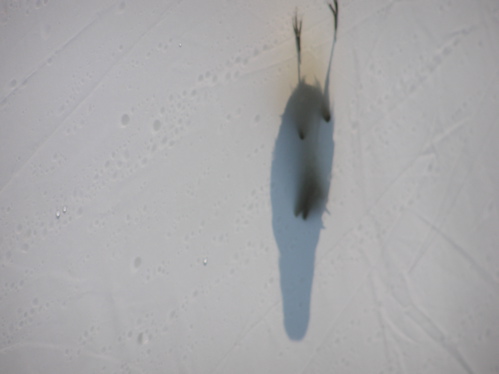 Avis shot out and Luther threw himself against the tent walls, trying to get in. I opened a flap and Luther shot inside. They spent the day together in the tent, gorging on mealworms. Avis and Luther thoroughly enjoyed each others' company, sitting glommed together on a perch, and Avis ate and bathed and preened all day. (Self-maintenance is one of the best signs of health in a bird. When a bird stops preening, it's not feeling well). I was moved by the strength of their bond. They definitely know they're phoebes!
By Sunday morning, it was clear that Luther was ready to get back outside. He was bored and wanted to get at all the flying insects he could see outside the tent.
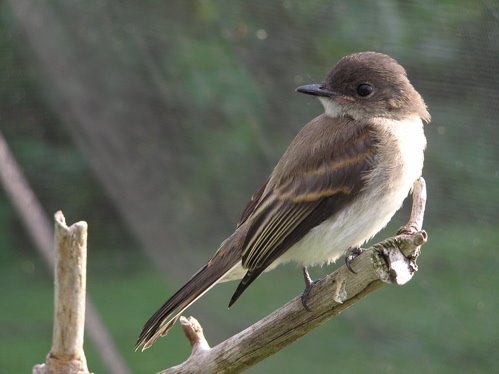 I opened the tent flap and held it aside, and he gladly zoomed out. Avis stayed put. She wasn't quite ready for prime time, and we both knew it. These birds are not dumb.
I'm writing this on Monday afternoon, July 3. I opened the tent today at about 3 p.m., intending to release Avis into the yard for another try at true freedom. Luther came right back inside when I opened the flap. He and Avis hung out for awhile, then both left. Avis flew all around the yard, perching in the birches, sunning on the telephone line. At 5 p.m. I took some mealworms out, and to my vast relief Avis swooped down and took two from my outstretched hand. She would need to learn to associate me with food if she would be able to make the transition to the wild.
At 6 p.m. I went back out to locate Avis, and she was sitting in the tent, having just had a meal from the feeder within. I couldn't have been more delighted. She knew where to return for food, without my being involved. She zipped back out to a distant birch clump. Good going, Avis.
In the interim, I've stopped hand-feeding Luther; he's got to take his food from a dish now.
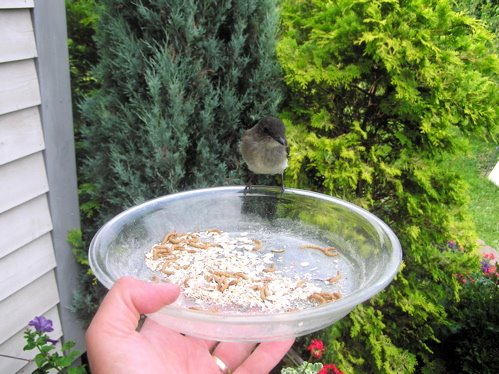 I'm making my forays outside less and less frequent, and I've been pleased to see Luther foraging actively all over the yard. Moths seem to be a particular favorite. Both Avis and Luther do a great deal of plunge-foraging, wherein they land on the ground, search around for a prey item they've seen, and take it back to a perch, bluebird-style. Luther even pulled an earthworm from the ground once, but he tasted it and rejected it. I wouldn't have thought a phoebe would do that. It is this behavior that makes them capable of eating out of a dish, and for that instinctive behavior I'm thankful. Swallows, for instance, do no plunge-diving, so they're pretty tough to feed once they fledge.
Those with no concept of the extended juvenile dependency period of songbirds might find all this feeding and training incomprehensible. Why don't I just kick them out the door and tell them farewell? Most people, even birders who should know better, seem to believe that once a bird leaves the nest, it's on its own. Not so; the parents feed it until its neural connections are all complete, until it's able to catch sufficient food on its own. The more complex the bird's foraging strategy, the longer the juvenile dependency period. American oystercatchers, which must learn to chisel shellfish off rocks and open bivalves by inserting their bills and cutting the adductor muscle, are dependent on their parents for at least 60 days! The adults open shellfish, feeding the edible parts to their young, as the juveniles watch and learn techniques.
I don't know how old phoebes are when their parents no longer subsidize them. I doubt anyone does. I can only try to judge their competence in foraging, and make sure that they know where they can always find food. I've seen adult tree swallows still feeding juveniles in mass migration flocks in September! Having hand-fed these birds since June 8, I'm not about to take the risk of starving them now. The nice part of all of this is that Avis and Luther much prefer winged insects to mealworms, and their instincts are in place and operating well. I get a big grin when I see one with a moth in its bill, beating it on a perch before swallowing it down.
Those of you who understand what I'm working toward know that my last intention is to make pets of these birds. On the contrary, I want them out of my hair--badly. And so I leave mealworms in their tent, with the flaps open, and I pop out of the house several times a day to call to them, offer food and make sure they're OK, and go back inside, slowly cutting the apron strings. Now that Avis is out, I can leave the tent open all the time, with the feeding station inside. So far, only my nesting pair of Carolina wrens has had the temerity to come inside the tent and load up on mealworms. There's no hiding anything from a Carolina wren.
Someone who's never raised orphaned songbirds can have little concept of what's involved in making them ready to fend for themselves. I hope, through this journal, that I've given you a glimpse of the work involved. I hope that you'll view wildlife rehabilitators with new eyes, and know a little bit of what's behind the "warm and fuzzy" image most hold of them. We're anything but bunny huggers; we're hard as flint at the core. We do what it takes to get these birds out the door, and we're not going to fall down on the job just before the finish line. There's too much invested. The reward is truly understanding how a bird thinks, how it develops, what it might do in any given situation. It's an understanding so deep that it goes beyond words. That understanding and empathy with wild birds is my pay for a job very few would ever want to take on.
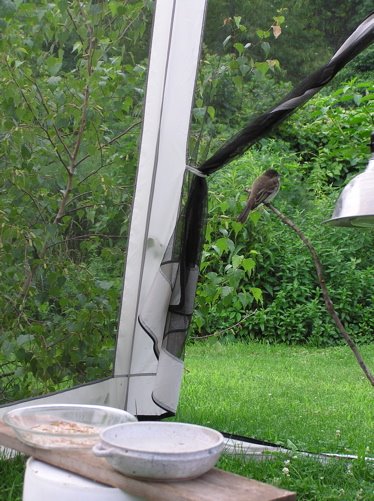
Avis sits inside the tent, food and water at hand, still free to come and go as she needs. Even though I know they're intelligent, I'm still agog that these two can maneuver inside the tent, feed, and then return outside. Phoebes have a penchant for entering structures such as caves and barns, so it's not surprising--but it is a delight.
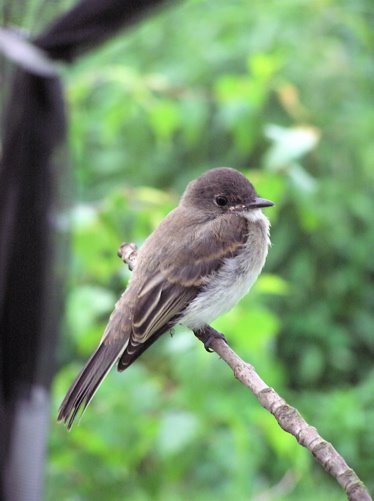 Avis, 6:48 p.m. July 3. She's 35 days old. It's her second visit to the food station inside the fledging tent since I released her. Freedom waits just outside, and she's taking full advantage of it. I am so proud of her.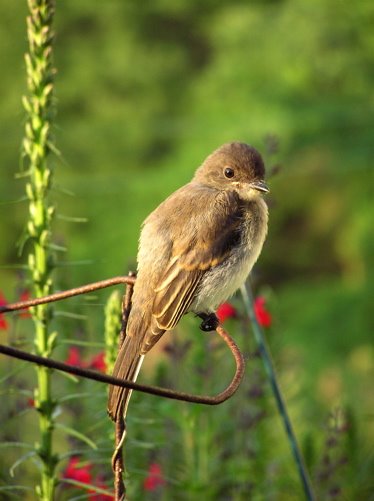
Luther, free in the flower garden. He and his sister are a couple of lucky phoebes. And I am honored to have been their caretaker.

posted by Julie Zickefoose @ 6:11 PM





<< Home