Life Bird, Life Mammal
A life bird is one you've never seen in your life. When you see it, you add it to your life list, and it becomes a life bird. Being a card-carrying Science Chimp, I keep life lists of mammals, butterflies, reptiles, plants, and what-have-you. I wish I were organized enough to write them all down, but I somehow keep the information in my head, and I know when I've seen something new, and especially when I yearn to see something new.
Lewis' Woodpecker is a bird I've longed to see since I was about eight, when I first saw an Allan Brooks painting of it in a book. The only pink and green bird in North America, it's a large Melanerpes, related to the red-headed woodpecker. It makes its living in much the same way as its more famous cousin, flycatching and caching acorns. Nowhere is it common, and we asked around until we found it was fairly reliable around Chama in extreme northern New Mexico, two hours from Taos, where we were staying.
I call Bill Logisto Mephisto for good reason. I had the bit in my teeth about getting to Chama, and was meeting some fair resistance from everyone else in our party, who didn't much fancy driving four hours to see one bird. So Bill got on the Net and located a Taos bird guide who was kind enough to tell him where, a year earlier, he'd seen Lewis' woodpeckers in Arroyo Seco, about five minutes from where we were staying! We followed explicit directions, stopped at a cattle grate in a dirt road, looked to our right, and spotted a pink, silver, red and oily green bundle of feathers in a dead apple tree. Bam!
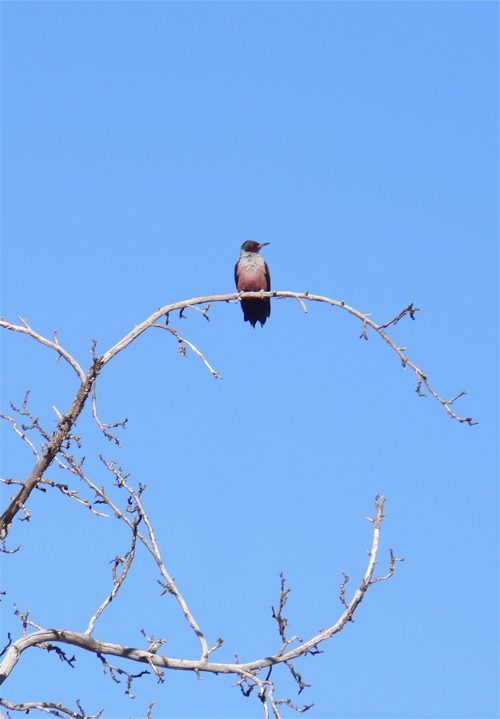 Wooooo Hooo! We spent the next hour and a half swiveling the scope and cameras around, trying to capture a decent image of these lovely big birds. Which, by the way, never sit still for more than ten seconds at a time. They look for all the world like miniature crows, very dark in flight, with the same wing-body proportions, much the same wing shape, and even the same cadence of wingbeat as crows. LEWO's have the habit of sitting on an exposed perch, then launching out in a wide circle. Much as this looks like the birds are hawking insects, Bill and I watched carefully, and never saw a hawking bird catch anything. We decided that the birds we were watching were doing it for some kind of display purposes, because at least five individuals were present, squabbling and flying in and out of a small grove of cottonwoods. The flight display was visible from a tremendous distance, and once we had an image of the birds, we could spot them from very far away by this distinctive behavior.
Every once in awhile a bird would descend to a small cluster of Gambel's oaks, hop around on the ground, and come up with an acorn, which it would break into pieces and cache in the bark of the cottonwoods. I wish I could show you a better picture of the filamentous wine-pink flank feathers of this beautiful male, but for that you'll have to visit Bill of the Birds' pre-emptive blog strike on Lewis' woodpeckers. Given their hyperactivity, getting a digiscoped picture of these birds in the tangle of cottonwood twigs took all his considerable scope-wielding skills. I know I'd never have gotten a look at them at all but for him. Thank you, sweetie, for setting me up. I took these snapshots with Shila's camera. Go look at Bill's now.
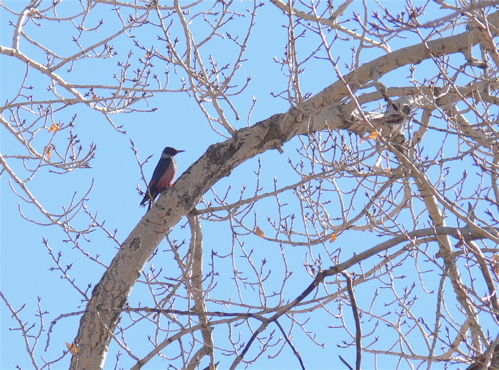
The next day, Bill and I spent more than two hours watching and sketching the birds, a delight, so relaxing. Neither of us are the kind to tick off a species on a list and move on. We want to know a little something about the bird, to feel we've given it its due. To live with it for even a little while. We never heard them make a sound but for a high-pitched rattling squeak when they were in conflict. More information is needed, perhaps the stuff of another trip to Arroyo Seco.
It took a very long time before I'd drunk in enough of these tremendously interesting and active birds to look about at my surroundings in Arroyo Seco. When I did, I noticed a yurt on the horizon, something you don't see every day. Immediately in front of the hutlike structure was a little knot of bovids, which I did not recognize at first sight. I moved closer, binoculars trained on the animals.
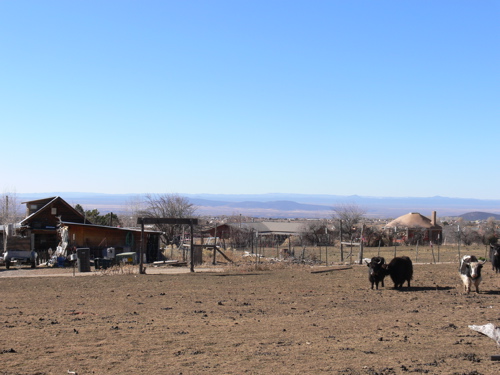 Could they be....yaks? Well, I didn't know, because I've never seen a yak, except in pictures, and on one particular blog I could mention. They were so small, so utterly adorable! Somehow I'd always thought yaks were great big animals. These were about a yard high at the shoulder. I would think that milking a yak would give you about enough milk for your morning cereal, and not a lot more. Maybe some to drizzle over the strawberries and make a latte with. Small animals.
It is at such times that being a Science Chimp is perfectly wonderful. You can flip through your library of mental images, stored over four-plus decades of staring at and subconsciously memorizing animal books, and definitively proclaim the identity of a small, cute, tiptoeing bovid for anyone within range who might care. It gives you a big, electric, nerdy thrill and edifies nearby parties (whether they care or not). And if you do it long enough, you really don't mind what they think of you and your proclamations, or the fact that you're talking excitedly to yourself: clinching the ID is the thing. You take your six-colored ballpoint pen out of your pocket protector and write, "YAK. Life mammal. November 22, 2006, Arroyo Seco, New Mexico, group of four with yurt. Also, five Lewis' woodpeckers. Life bird. Same place!!"
Then you snap your pen, adjust your thick, tape-mended specs, hike your pants a little higher, and get on with your bad self.
I kept moving closer, snapping away. The kids got caught up in the moment and ran to the fence, drawing the yaks closer with curiosity.
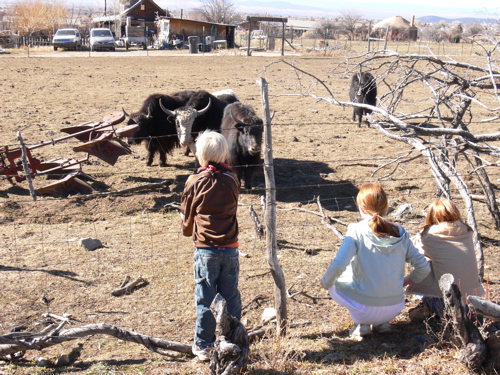 Yes. Yaks they were. Life mammal!
Oh, adorable bovids. They looked like they were wearing too-small wooden shoes. They licked each other a lot. I think the parti-colored one was Dad, and the slightly smaller one in the back with finer horns was Mom. And I think the two black ones in the front were their twins. At least that's what I decided. I couldn't sex them; there was too much hair hanging down. But Mr. Parti-color looked decidedly guylike with this curly forehead and heavy horns. Yaks (Bos grunniens) have been domesticated for longer than just about any animal, having first been kept by the ancient Qiang Chinese about 4,500 years ago! There are still wild yaks, but they are endangered, probably less than 15,000 in number, and larger than their domesticated counterparts. For a fabbo rundown on yak faks, see this link.
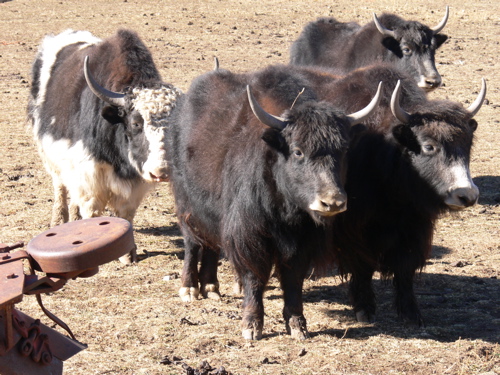
We never succeeded in luring them close enough to touch, though we tried every endearment we could imagine. I suspect we were not speaking their language. I could tell these yaks were well-treated. Nothing that cute could be mistreated.
I do not know where one gets yaks, any more than I know where one gets a yurt, or plans for one. I am just glad that somewhere in the New Mexican hinterlands, there are yurts, and yaks. FYI they did not seem to have any need to be herded; they seemed content to find their own way in the world.
Once I started learning about yaks, I could not stop. I was distressed to learn that people eat them, but I suppose that is the lot of most bovids when you think about it. They're also highly prized for their fiber (which I assume refers to their coats). I quote from the website of the International Yak Association: "We have only begun to expound the virtues of the yak. For those whose interest is piqued, please feel free to contact us for more information. We have members exploring every asset of the yak and we are happy to share our discoveries."
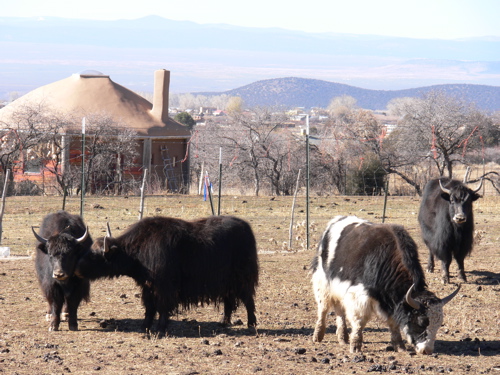 This one's for the Swami. May you continue to explore every asset of the yak.

posted by Julie Zickefoose @ 11:25 PM






<< Home