Seeing Eohippus
So we're back from another pretty terrific weekend away, and Bill's camera has all the pictures on it, so I'm becalmed for awhile until he downloads them. I got to thinking that there were some images from the Guatemala trip that are orphaned in my February Blog folder. Two are of agoutis. (ah-GOO-tees)
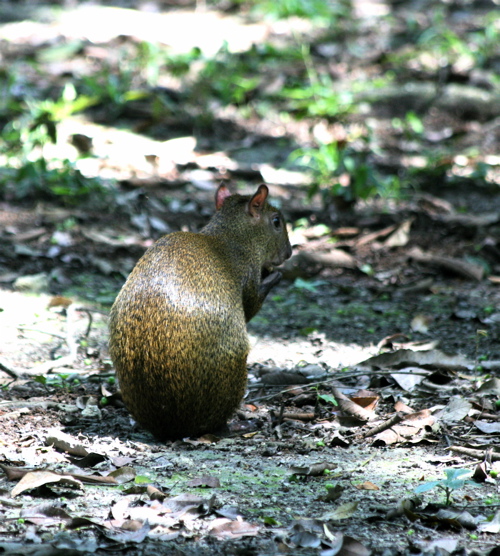 Agoutis are large, leggy rodents, kind of like guinea-deer. Or squirrel-duikers. Squirrel nut duikers. Although I spent six months in the Amazon of Brasil and have been to Costa Rica three times and Guatemala and Mexico, I had never seen an agouti in the wild. It's the edible-animal syndrome: anything big enough to roast on a spit is pretty much extirpated wherever people live. But Tikal National Park in Guatemala, a wonderland where everything that should be in the humid lowlands IS in the humid lowlands, is an exception to that rule. And so we saw two agoutis, along with roastable guans and currasows.
Something about this animal rang a distant bell for me, and I realized as I sketched it that it was its resemblance to Eohippus, the "dawn horse." Maybe the agouti is shorter necked, but there was something so proto-horse about this little animal. Lovely. I think it's the cursorial foot and the delicate, deer-like legs. Look how the toes, which would be all ganged together on your usual squirrel or rabbit, are strung up the leg. Cursorial, or running animals usually have just one or two toes that they run on. You can run faster if fewer toes hit the ground--it's more efficient. Think about ostriches, which have just two toes that hit the ground, kind of like a cloven hoof. Horses, of course, have just one surface--the toes are fused into a single hoof. How did that evolve? Well, I guess the ones they didn't need just migrated up the leg and disappeared. You can see that happening on the agouti, right here. What's totally cool about agoutis is that they still manage to use their front paws like squirrels do, as evidenced in the top photo.
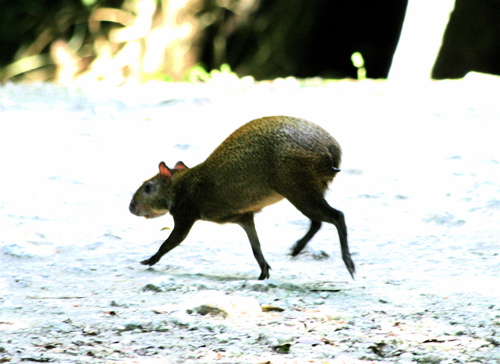 Gotta love those agouti 'tocks. This animal is such a kick. When I draw it, it's all I can do not to add a swishy tail and lengthen that neck a bit. It's like looking back into the mists of prehistory and being allowed to see the first little horses.
Speaking of prehistory, the cloud forest in the highlands around Coban, Guatemala was full of tree ferns. These are impossibly elegant plants that tower up and make the most fantastic lacy patterns against the sky.I'm always humbled by tree ferns, because they have survived the dinosaurs, unchanged since brachiosaurs munched on their fronds. You have to be respectfully silent around a plant that ancient.
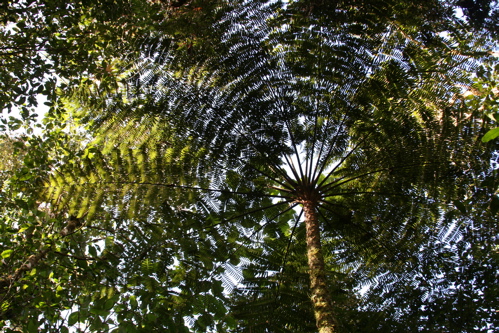 As we drove through the highlands, it was hard to see the cloud forest being felled for agriculture. Especially hard to know that people were trading the incredible diversity and beauty and unique habitat of cloud forest for plantations of leatherleaf. You know that leathery, dark-green fern that's in every darn carnation or rose bouquet you buy? Well, it's grown in what used to be cloud forest. People cut all the forest down and scalp the mountainsides, and put up shade fabric on wooden posts, and grow your bouquet leatherleaf where there used to be bush tanagers and solitaires, howler monkeys and quetzals. I have come to hate leatherleaf, and all the habitat destruction it implies.
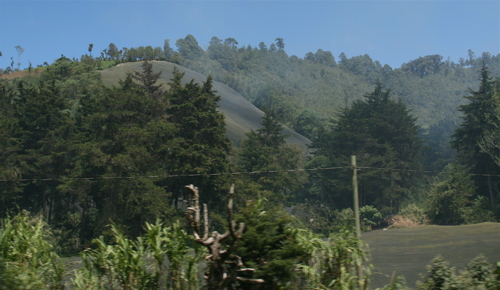 You can see the scalped hillsides, covered with smooth shade fabric. What a trade.
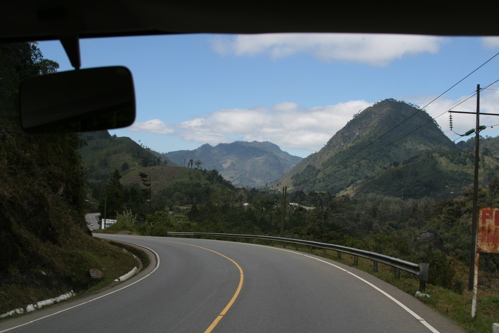
Here's a peek out the windshield of the bus as we drove through the highlands. I got lots of pictures like this, because I couldn't ride in the back of the bus on roads like this. Blarrggh!
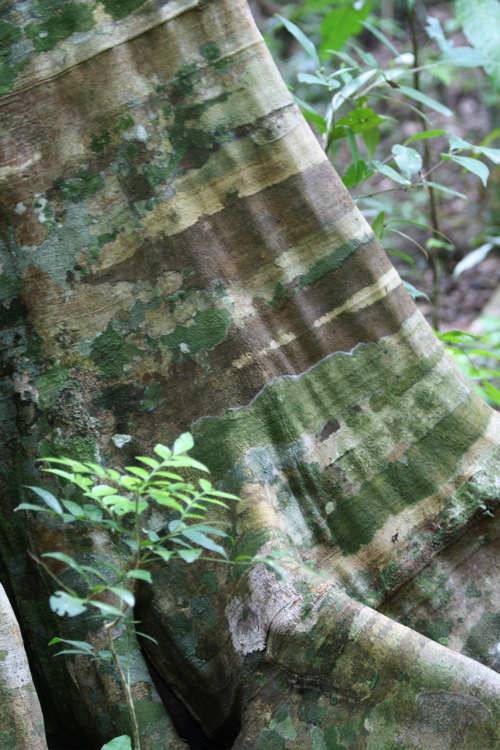
Where soils are thin and it's very wet, trees have to buttress themselves against falling. They make buttress roots, which spread out like feet at the base of the trunk. Lots of different species make them, because all the trees are in danger of blowing down or just losing their footing in the torrential rains. One of the countless things I love about the tropics is the unexpected beauty, that reveals itself in the oddest places and ways. Look at the patterns and colors on these buttress roots. You could make an entire room design just from the artwork on this one buttress. Ahhh. Beauty. Addictive, and everywhere. How handy!
Labels: agoutis, buttress roots, cloud forest

posted by Julie Zickefoose @ 10:09 PM






<< Home