Monday, April 02, 2007

Box Turtle Mysteries

Well, the wait is over. Early last June, I found a female box turtle laying eggs in our meadow. I left her alone, marked the spot with a Kleenex, and returned first thing in the morning to cage the nest, to protect it from digging mammals, egg-loving snakes, and crows. I put a fine-mesh cage over the nest proper, with 1/2" hardware cloth, and a large iron milk crate over that. I drove stakes in to firmly anchor the outer cage, knowing the strength and determination of raccoons. Last summer, I found three box turtle nests along the same path, all of which had been dug out by coons or skunks.

Knowing that box turtle nests need about three months to incubate, I began checking the nest every couple of days in September. Nothing, nothing, nothing. Nothing through October, and then it was too cold for the hatchlings to emerge. A certain percentage of hatchlings emerge in spring. I checked on it all winter, and began checking it this spring on warm days after rains. I worried all winter that my driving the stakes in the day after they were laid might somehow have addled the eggs with vibration.

Today, while working on a painting, I got an overpowering feeling that something had happened at the nest. Chet and I trotted out the meadow, and I peered into the cage. I couldn't tell, with all the overgrowth, whether I was seeing what I thought I was seeing. I yanked the stakes up to find two small exit holes, and a tiny box turtle hatchling, nose down in a shallow scrape in the clay. I was shaking with excitement.

Gently, I pried the little turtle out of the clay. It was so tiny, it could fit on a quarter. Its shell was soft and it was motionless. Slowly, it dawned on me that this hatchling was dead. I was crushed. and determined to figure out why. My CSI tendencies kicked in. First, it was clear to me that it had died very recently, perhaps even this morning. There was no odor, and it was stiff with rigor mortis. There was something very wrong with its eyes and beak; they were covered with a pinkish membrane that I cannot remove. It could not have opened its eyes or breathed, except perhaps through its mouth. I thought at first this might be an egg membrane, but it seemed too tough. I still don't know whether this was a birth defect or an unusually tough membrane that adhered to the turtle's face in hatching. More of the pinkish membrane appeared along the sides and top of its shell. Again, it couldn't be peeled off. I began to think that this turtle had a birth defect. How sad.
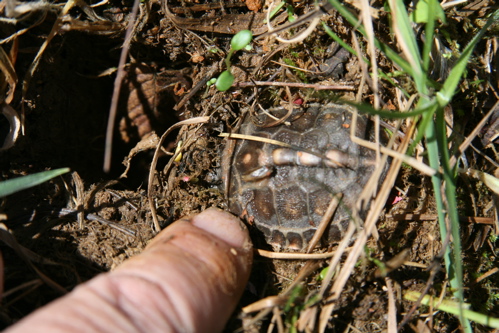
The yolk sac had been completely absorbed, making me think that this turtle had hatched last fall and slept in the scrape over the winter. Clearly, it had enough energetic resources to dig out (no small feat, given how many roots had infiltrated the chamber). How it did that with its nostrils and eyes covered up I don't know.

Here is a picture of the entire scene. You can see one dark exit hole to the upper left, and the second one is to the right of the turtle, just to the right of the three grass blades.
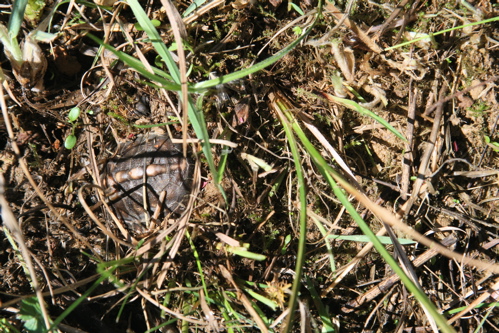
I dug more, very carefully. First, I found an addled/infertile egg that had collapsed, entire. Then, two eggshells that had been hatched out of. One must have belonged to the dead hatchling. The other must have belonged to the turtle that made the second exit hole. But where was that turtle? I searched through the grass for several feet around the nest, finding nothing.
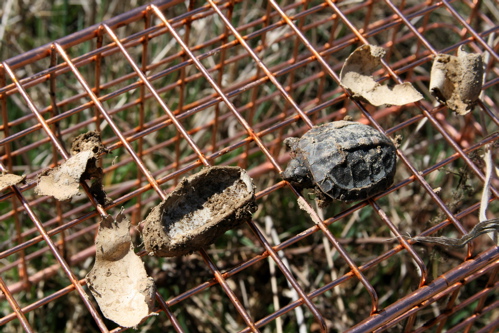
I dug out the entire scrape. No hatchling. I can only think that the second hatchling must have dug laterally until it was out from under the small, inner cage, then exited the large milk crate and set out for parts unknown. It's also possible that it made its way out of the small cage via the larger corner holes. If there even was a second hatchling. But the eggshells and the second exit hole argue strongly that there was.

As is often the case in nature sleuthing, I'm left with more questions than answers. Did I do any good here? Did I cause the death of the unhatched egg, or somehow cause the death of the defective hatchling? Is there one tiny turtle crawling the planet who would have otherwise been lost to predators? I don't know the answers. I can only think about how to do better by them this year, if I get the chance.
To all those who've been waiting, and especially to Kai, I'm sorry I don't have a happier story for you.

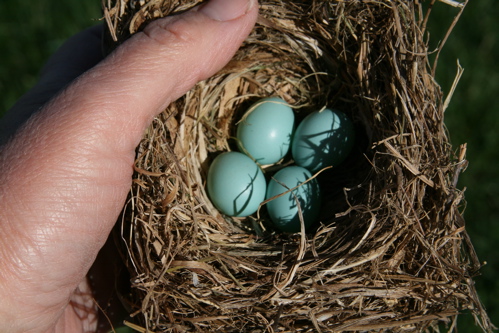
Meanwhile, in the front yard box, life is beginning. Four warm bluebird eggs on March 30, five eggs on March 31; projected hatch date April 12.

Labels:

16 Comments:

At 6:45 PM, Blogger Liza Lee Miller said...

Oh, Julie, what a sad finding. Thank you for sharing though -- it was fascinating. Sometimes nature is terrible as well as marvelous. And thank you for sharing the hope of those four (now five) tiny blue eggs.

 
At 6:56 PM, Anonymous katdoc said...

How strange. I was just thinking during my morning commute that I hadn't heard any box turtle news and wondered what was happening with them. How sad to find the dead hatchling. I like to think that one made his way to freedom and life, thanks to you.

My bluebird eggs are on the same schedule as yours, 5th egg laid March 31, but I have calculated a different hatch date. I was counting 14 days incubation, not 12. With this weekend's temps predicted to drop into the 20's, I wonder if that will cause a delay in hatching.

Eastern Phoebe with nest material today! Is this the first year I get baby pheobes?

~Kathi

 
At 7:08 PM, Blogger Trixie said...

Wow! What a story. Very intriguing. I would say that there is one more turtle in the world because of you. I guess I am an optimist.

Oh, and lovely bluebird eggs.

 
At 7:14 PM, Blogger Julie Zickefoose said...

Hi Katdoc--congratulations on the nesting phoebes!! Envy! I have a singing male but no female as yet that I've seen.
I calculate bluebird incubation as starting with the laying of the third or, to be conservative, fourth egg. The four eggs were warm on March 30, so that gives two days of incubation in March, plus twelve in April, for a total of 14. The fifth egg just has to catch up on only 12 days of incubation. The embryo's development speeds up when it hears the peeping of the chicks in the eggs next to it. Cool, huh?
But you're right--very low ambient temps. are predicted so the actual incubation period could vary from the norm of 14 days. It depends on how close a sitter the hen is. Mine is very flighty.
It definitely helps to have bluebirds nesting (though I'll have to worry them through the cold spring). Going out to bury the turtle now. Sigh.

 
At 8:32 PM, Anonymous mon@rch said...

Nature isn't always kind but lets hope the one made it! Congrats on the bluebird eggs and can't wait to see when my little guys decide to start sitting. Thanks for taking the time describing your CSI efforts!

 
At 7:47 AM, Blogger Mary said...

From one turtle lover to another, I understand your disappointment but I'll bet there's a young one out there that made it! And then you find bluebird eggs - the silver lining!

 
At 8:39 AM, Anonymous Anonymous said...

Hi Julie-

I've been waiting to hear about your box turtles and am so sorry about your find. Per your advice I have had a milk crate protecting our turtle eggs since last July and have seen no obvious changes in the dirt/mulch under it. I will have to do a little detective work this evening.

Caroline

 
At 8:48 AM, Blogger Rondeau Ric said...

To paraphrase
It is better to have tried and failed than to never have tried at all.


RR

 
At 8:59 AM, Blogger Julie Zickefoose said...

Caroline,

Especially important to keep a close eye on that nest after the big recent rain, and with the cold coming Wednesday night. It probably wouldn't hurt to poke your finger around in the mulch a bit to see if you have turtles already emerged, and dug back in.
Rondeau, "loved and lost" sums it up perfectly.

 
At 10:25 AM, Blogger robin andrea said...

Sad, but enlightening story. That's very good sleuthing, Julie. I always appreciate the effort you make to sustain and protect the wildlife around you. Looking forward to your posts about the soon-to-be bluebird babies.

 
At 3:18 PM, Blogger littleorangeguy said...

When I found a cardinal dead outside my bedroom window a few years ago, I saw to it that he had a decent burial, even if it was outside a small Toronto walk-up. But I remember thinking that a naturalist would think me crazy for a sentimental act. It's nice to be wrong -- seems you might have done the same thing had you been me!!

Walked home this afternoon to hear --and see-- a romantically-inclined (I guess!) cardinal flying like crazy between the Norway maple in our front yard and the Silver maple in our back yard. What a pleasant sight (and sound) he is, as are the fat little juncos in their tuxedo tails, in the middle of the city.

 
At 6:45 PM, Blogger KGMom said...

I read your story when you first posted, and had nothing to say (feeling too sad). Then just tonight in talking with a neighbor she asked if I had seen their turtle--a 3 toed turtle. It seems her husband had put it in a plastic playpen outside, and it got out and wandered away. That made me very sad--that people who have a turtle as a pet (which I wouldn't recommend) would not care for it properly.

 
At 6:50 PM, Anonymous katdoc said...

Checked my bluebird records for the last few years. With one exception, the first clutch incubation has always been 13 days, and 12 days for the second. The one exception was 15 days during one particularly cold, wet spring. I have never had 3 clutches in a season. With them starting so early this spring, maybe this will be my year.

~Kathi, who hasn't yet found a phoebe nest

 
At 9:41 AM, Blogger dguzman said...

Sorry to hear about the turtle losses, but I'm hoping for that one little guy out there! I'm sure he's there somewhere.

What beautiful blue eggs!

 
At 8:45 PM, Anonymous Anonymous said...

runescape money runescape gold runescape money runescape gold wow power leveling wow powerleveling Warcraft Power Leveling Warcraft PowerLeveling buy runescape gold buy runescape money runescape items runescape gold runescape money runescape accounts runescape gp dofus kamas buy dofus kamas Guild Wars Gold buy Guild Wars Gold lotro gold buy lotro gold lotro gold buy lotro gold lotro gold buy lotro gold runescape money runescape power leveling runescape money runescape gold dofus kamas cheap runescape money cheap runescape gold Hellgate Palladium Hellgate London Palladium Hellgate money Tabula Rasa gold tabula rasa money lotro gold buy lotro gold Tabula Rasa Credit Tabula Rasa Credits Hellgate gold Hellgate London gold dofus kamas buy dofus kamas 血管瘤 肝血管瘤 音乐剧 北京富码电视 富码电视 富码电视台 7天酒店 7天连锁酒店 7天连锁 自清洗过滤器 过滤器 压力开关 压力传感器 流量开关 流量计 液位计 液位开关 温湿度记录仪 风速仪 可燃气体检测仪 wow power leveling wow powerleveling Warcraft PowerLeveling Warcraft Power Leveling World of Warcraft PowerLeveling World of Warcraft Power Leveling runescape power leveling runescape powerleveling
runescape money runescape gold wow power leveling 棕榈树
eve isk
eve online isk
eve isk
eve online isk

 
At 1:43 AM, Blogger Roger David said...

Play Roulette for free as often as you like, get a feel for the game and how to place you bets.
Free Roulette is a great game with many ways to bet so learn strategy and have fun.

Roulette is a casino and gambling game named after the French word meaning "small wheel".

The roulette wheel is believed to be a fusion of the English wheel games ... The American style roulette table with a wheel at one end is now used in most casinos.

Is a Free Roulette Systems 100% Effective Or Should I Pay For One?

They are a dime a dozen, but there are only a few
roulette strategies that really work. Also I think it is great if you
can find a Winning Roulette Systems, because these roulette systems really do beat the wheel time and tiem again.


Post a Comment

<< Home