Thursday, July 19, 2007

Lost in a Gull


I’ve blackened the gull’s name and reputation in previous posts. It feels odd to be passing judgment on birds I admire so much. Gulls can’t be blamed for taking easy prey, and exploiting spilled bait and incidental catch of the lobster boats. They are supreme opportunists, long lived and crafty. But what kind of predator virtually eliminates its prey base, takes almost every hatchling? What is going on here between gulls and eiders? And what will we do about it, if anything?

On Monhegan Island, we hiked across from the ferry dock to the cliffs on the lee side of the island, some eight miles out from the mainland. Vicious currents make this a deadly spot for anyone who enters the water. No one who has gone overboard on the lee side of Monhegan has ever been saved, according to the tourist brochure that spells out a detailed code of conduct for this tiny but heavily used island. All right. We wouldn't so much as stick a toe in the surf.

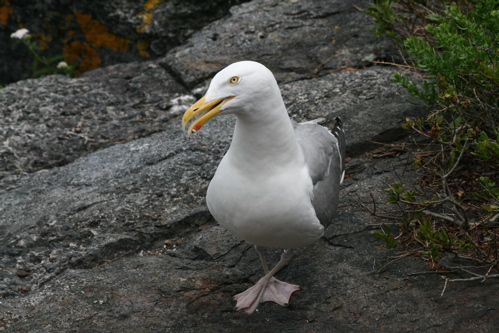
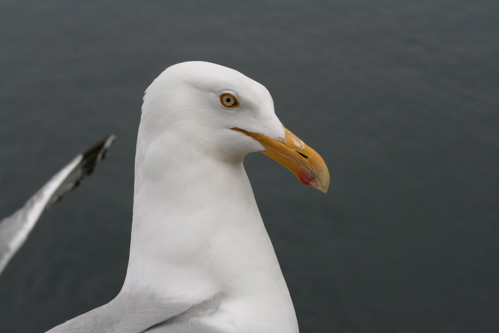
This gull noticed that we had food with us, sandwiches and other prime gull fare. She pressed close, close enough for me to notice the sloping brow that characterizes a female herring gull. (The male’s is much steeper. The same difference applies to male and female common loons). She appraised us with icy yellow eyes, looking for her chance, perhaps beseeching. We tossed her a bit of pizza crust now and then, and I got lost in the intelligence in her cool lemon eyes.This creature might live 30 or more years. She knows a lot. She knows I am going to cave in and give her some pizza now, and maybe a little bit of my Italian panini sandwich. Oh, yes, she knows.

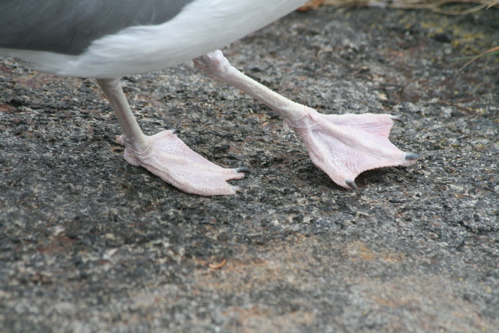
When she felt conflicted or ill at ease, she'd stare at her feet, the way a raptor does. I found that interesting--that behavior crosses taxa. And found myself wondering how many other birds foot-stare when they don't know what else to do. Herons? Storks? Rails? Ostriches? I'd love to know. I like the old-lady pink of her feet, the out-turned toenail on the outer toe.
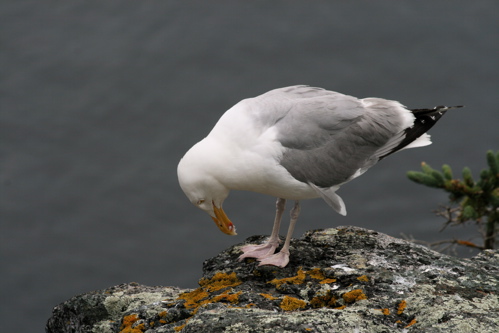
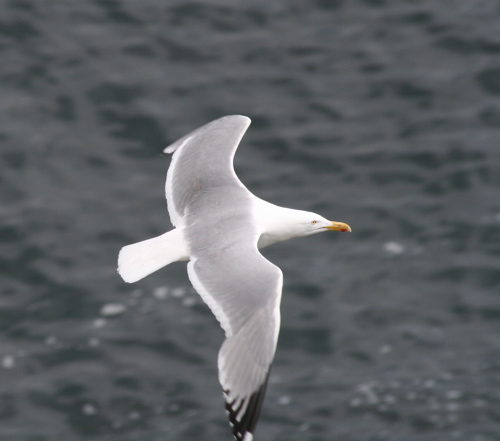
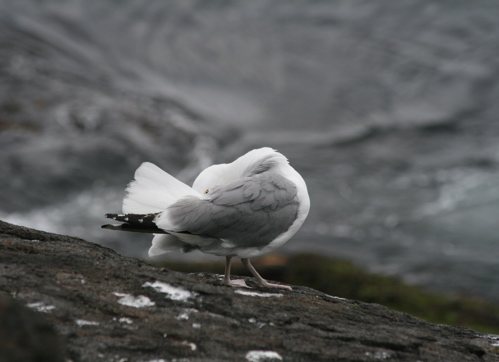
Lost in the curve of her wings, and the ease with which she lifted off over the roiling ocean. How I wanted to fly with her. My bones felt like lead, rooted to the rock and lichens.She preened calmly as the surf boiled hundreds of feet below. Overcast, pewter surf--could there be a more perfect photographic salon for a silver and white bird?She took grass to her nest on the cliff face. A shape-shifter, she is. How does she do that with her primaries?She was perfect, immaculate, mistress of the updrafts, bent on survival.
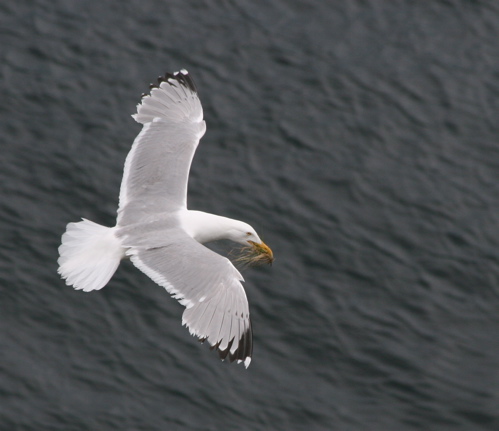
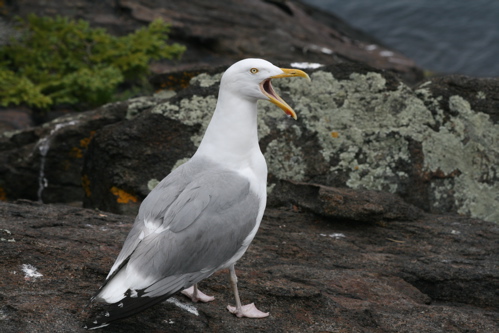
Who can blame her for taking what is offered her, be it bread or duckling? She is no different from me. I don't hate gulls. I wish they didn't eat eiders, that's all. And I feel immeasurably blessed to have spent a few hours in her company, and to be able to share her beauty with you.

Labels: , ,

20 Comments:

At 7:32 PM, Blogger Trixie said...

I am always amazed at how far out to see I have seen gulls. They are amazing.

 
At 2:17 AM, Blogger BT3 said...

Nice one, Zick.
One correction--that wasn't nesting material, that was a bill-full of sesame noodles I made for her.

 
At 5:21 AM, Blogger KatDoc said...

Why are we so quick to condemn birds (or other animals) for doing what they are built to do, or what they learn to do, to survive? We call it intelligence when snow monkeys learn to sort rice grains from sand by tossing handsful into water (the rice floats, the sand sinks.) We call it cruelty when gulls feed on eider chicks or laziness when cowbirds practice nest parasitism, when in truth, all those labels are based on human emotion, not animal nature.

Why is one gull beautiful and remarkable, and hundreds or thousands of gulls are "those stinking birds?" Why do I have nothing but questions this morning?

Nice post, as always. Love the pink toes!

~Kathi

 
At 5:39 AM, Blogger Jayne said...

They are highly adaptable, no doubt. Otherwise, what would they be doing in a Wal-Mart parking lot in northwest Georgia? It always freaks me out a bit to see them there.

 
At 6:48 AM, Blogger RuthieJ said...

hmmmmm....I stare at my feet when I'm conflicted or ill-at-ease too (so I guess maybe it's not just a bird trait or am I really more birdy than I thought?

 
At 7:45 AM, Blogger Mary said...

Julie, you've never blackened their name. You talked about a circumstance affecting Eiders, that's all. Gulls do what they do and it's all fine.

I'm so amused about the foot-staring. I never noticed it before. I'm still laughing about it!

 
At 8:38 AM, Blogger littleorangeguy said...

Simply beautiful pictures of such a common, pesky bird. And a great teaching moment too: I really appreciated the little lesson on looking at one's feet -- what it means, and the fact that it is a shared behaviour.

So, a new appreciation for the noisy bird I grew up with alongside the Atlantic and some version of which remains in my life, wheeling over the east end Toronto grocery store parking lot I pass on my way to the subway every day!

Have you ever seen gannets? Perhaps when you were in Newfoundland. Years ago I was on a boat trip out around a bird sanctuary and the guide pointed me towards a pair of gannets. He said: "Those are fierce birds." I thought he meant they were vicious, but it turns out he was talking their fierceness of devotion to each other; he said they mate for life, and he talked about trying to rescue a male who refused to leave his injured mate, which had been fouled in a net. It ended up there was nothing the guy could do to save either bird, but he said he would never forget looking into the dark blue depths of the male's eye -- it was like it would never end. He was a pretty rough guy, and hearing him talk like this was incredibly poetic. Until that day, I had never thought gannets were anything other than different-looking gulls. And I guess that was the first time I felt a pull towards learning more about birds.

One final note: certain begging behaviour in the herring gull reminds the reader of certain begging behaviour in the Boston. Who needs taxa? Is this an example of behaviour crossing species???

 
At 8:43 AM, Blogger Rondeau Ric said...

"But what kind of predator virtually eliminates its prey base, "

Man.

Look what we Canadians did to the Atlantic cod fishery.
Then look at what we are doing to the temperate rain forest on the west coast.

Stupid people.

RR

 
At 9:45 AM, Anonymous Anonymous said...

Carolina chickadees stare at their feet--they look as if they're making sure that their toes are still there.
Sharon from Fred'burg,VA

 
At 11:13 AM, Anonymous LNMP said...

I am admittedly not big fan of gulls, and take some ribbing from my fellow birders about it. But I have to say your post gives me new appreciation for them. Well, at least one of them! ;)

 
At 11:30 AM, Anonymous mon@rch said...

This is soo wonderful Julie! I must say that I have found myself looking down when bored!

 
At 3:49 PM, Anonymous Walter Wehtje said...

They're not only scavangers. check out this Herring Gull from Scotland http://news.bbc.co.uk/2/hi/uk_news/scotland/north_east/6907994.stm

 
At 4:05 PM, Blogger Ivy said...

I love that birds look at their feet when they don't know what to do or are ill-at-ease. Just like me.

 
At 5:39 AM, Blogger Mary Richmond said...

Hi Julie--I hate to contradict you but I heave heard this from several bird and gull experts--including Wayne Peterson--that gulls are draining their salt glands when they seem to be staring at their feet. Gulls can drink salt water and have glands that extract the salt that then must be drained daily. Are they sometimes staring at their feet because they're conflicted instead of draining salt? We'll have to ask them....

 
At 6:21 PM, Blogger robin andrea said...

I'm glad you wrote this. I'm pretty sure it's only humans that take animals for sport and entertainment, and as ric noted, we eliminate food bases too. When I watch a crow snatch a nestling it breaks my heart, but intentionality is everything.

That foot staring thing is really interesting behavior. I'll have to keepy my eyes open for that.

 
At 12:25 AM, Anonymous Anonymous said...

I remember the movie "Finding Nemo" and the voice of the gulls, "MINE! MINE! MINE!" absolutely perfect for gulls.
jeanette

 
At 5:44 PM, Blogger janet said...

Herring gull salt glands are located above the eyes, so that argues for Mary's comment that they're draining the salt glands when they stare at their feet.

RE begging behavior, too bad Tinbergen only analyzed the begging behaviors between herring gulls themselves, not between herring gulls and people. For those not as science chimpy as Julie who has no doubt read this a dozen time, Niko Tinbergen wrote a famous book called The Herring Gull's World, one of the pioneering works in ethology.

 
At 5:54 PM, Blogger Julie Zickefoose said...

I'm wondering if other birds with salt glands (eiders, tubenoses) have the same "foot-staring" behavior, and if you can actually see a drop of salty water after such head dips. More information needed. As always. And I would like to ask the gull why she does it. ;-)

 
At 3:52 PM, Anonymous Mary Jo said...

My cockatiel, Elvis stares at his feet, even when he is in the middle of doing something else. He will be preening one moment then staring intensly at his toes the next. BTW how is the Charlie bird it's been a long time since you have posted about him?

 
At 3:56 AM, Blogger Wes said...

winning roulette systems | free roulette systems | roulette strategies | how to play roulette | online roulette | how to win at roulette | roulette | free roulette | tips for roulette | roulette system


Post a Comment

<< Home