Crane Confrontation
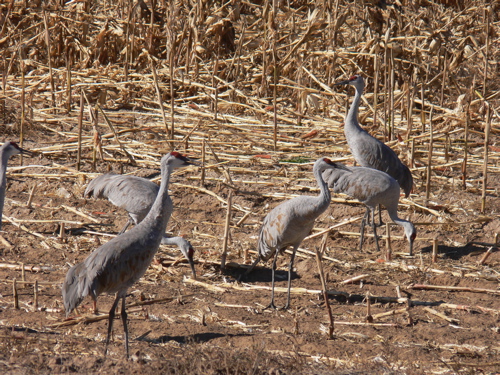 Watching the sandhill cranes at Bosque del Apache NWR is an education in itself. They travel in family groups, often two adults with their two kids from the year, and they talk constantly, gutteral, resonant purrs from the adults, and tweedling chirps from the juveniles. Seeing them pal around must be hard for a solitary great blue heron. I watched in amazement (and remembered to shoot pictures) as a lone heron flew over to join a small family group of greater sandhill cranes. What could he have been thinking?
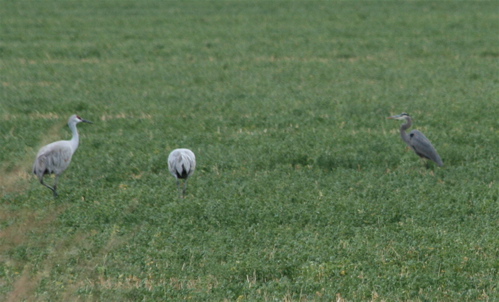 He's in their personal space. The cranes dawdle over closer to him. How touching.
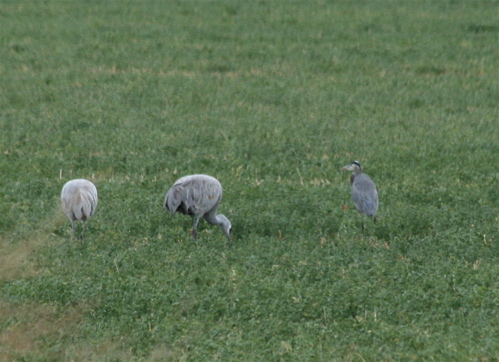 Or not. I had a pretty good hunch that the cranes would send the heron packing, and sure enough, when they got closer, they raised their stately necks and inclined their bills, giving a clear cross-species threat to the heron.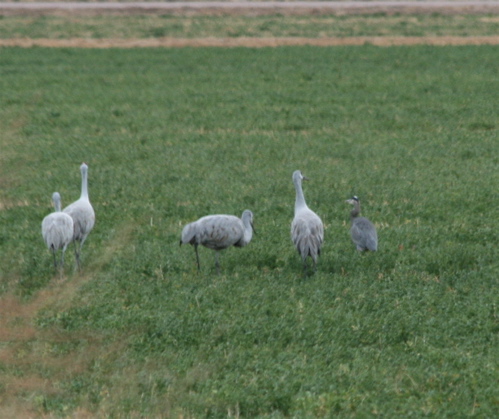
You can see that the heron is already gathering its neck in for takeoff. Wise move.
Cranes, by the way, fly with necks extended, and that's a quick and easy way to tell them from herons in flight. Cranes also lack a functional hallux, or hind toe, so they can't land in a tree like a heron can. They are open country birds, who can't perch but must stand on solid ground or in shallow water. This impacts their habitat preferences and natural history in lots of ways. (Thanks to Paul Tebbel for some thought-provoking conversation on cranes while we drove around in his truck).
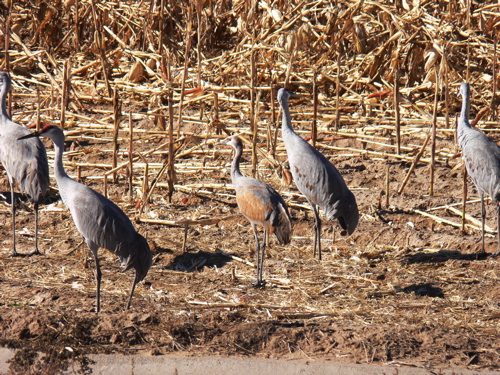 There are two species of sandhill crane at Bosque del Apache, the greater and lesser sandhill cranes. Lesser sandhills are much smaller than greaters (the bird in the middle with brown wings is a lesser sandhill). They also tend to "paint" their wings more heavily with iron oxide, so they really stand out in a crowd. Yes: cranes decorate their feathers by painting them with red-staining mud. That's why you'll only see the stain on the parts of their bodies they can reach.
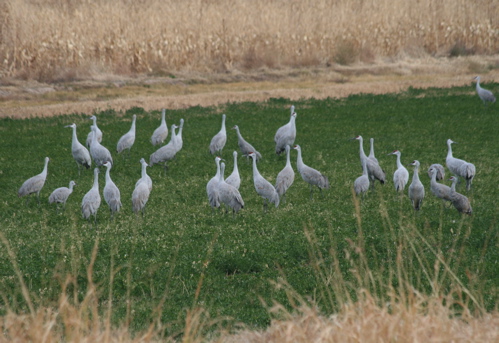 Cranes on green, a lovely sight. The second bird from the left is probably a lesser sandhill crane. In the photo below, the brown-winged lesser sandhills are easy to pick out, markedly smaller than the pale greaters.
 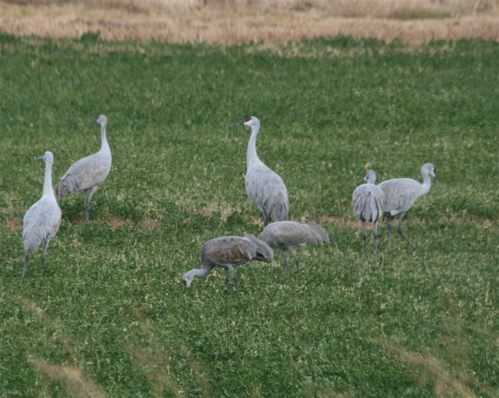 How I miss their resonant calls. Cranes are addictive.
It was a snowy day here; the kids were home from school, and so was Bill. What a nice feeling, to have us all together in a warm house. Kids played outside much of the day. Bill built them a mogul right before dark and they caught some sweet air going over it in the toboggan. Baker frisked around for about ten minutes at a time and then came in all shivery and grunty, wanting to be wrapped in a down comforter. I got some cute pictures of him googling along in the snow. All in all, we got about 8", and there are high hats on all the bluebird houses. I shoveled out the cardinals before dark, and left some corn for the deer out under the pines. Did two watercolors, diverting myself between washes with an excellent and thought-provoking discussion of sandhill crane hunting. You guys are the bomb. Thoughts were firing back and forth in private e-mails, too, about aesthetics and hunting and whether we have the right to hunt cranes. Nobody hunts flamingoes. What if sandhill cranes were lucky enough to be pink?
Time to fix dinner--a chicken, but not a prairie chicken. Life is full of ironies. Stay warm.
Labels: crane plumage painting, great blue herons, lesser sandhills, Sandhill cranes

posted by Julie Zickefoose @ 6:14 PM






<< Home