Thursday, September 28, 2006

Turtle Bone

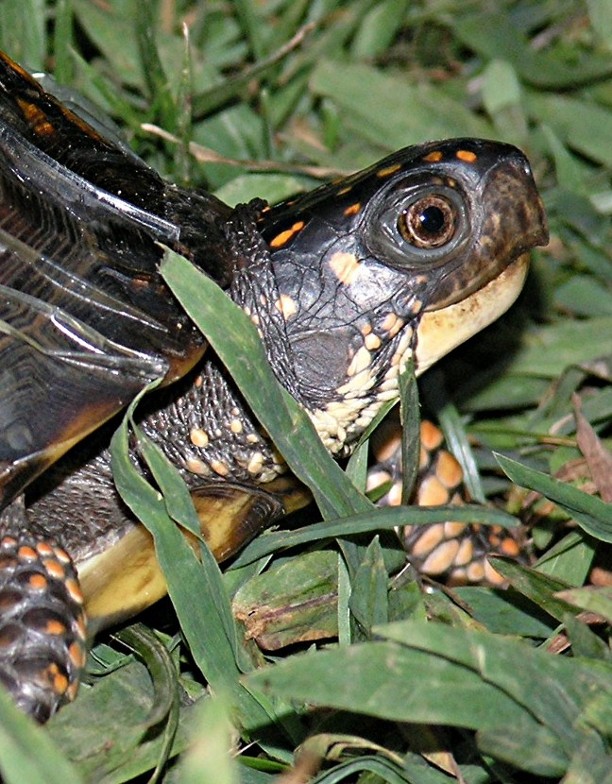
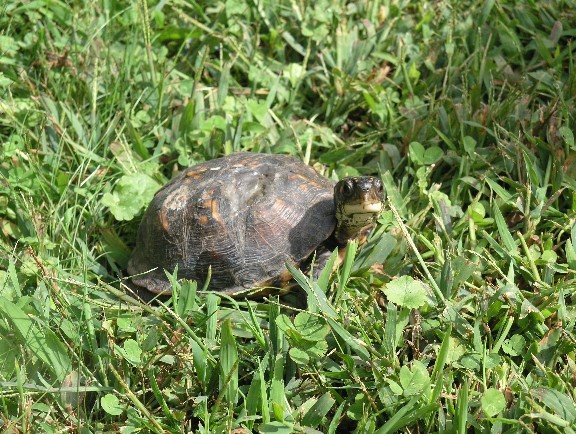
Carol Foster continues to send photo-updates of lucky Belle, the box turtle who ran afoul of a mower this summer. She and her husband Gary are taking wonderful care of Belle. They're planning to keep her eating and active all winter, to speed healing of the wounds. Carol has a Real Camera, a Canon, the kind I would like to get if I ever have any money that isn't already devoted to replacing furnaces, paying mortgages and buying books. When I see her pictures, I know my limitations. Carol and Gary are sneaking romaine lettuce into Belle's canned chicken, and dosing her with vitamins. I think she looks fabulous. This closeup was taken Sept. 6.
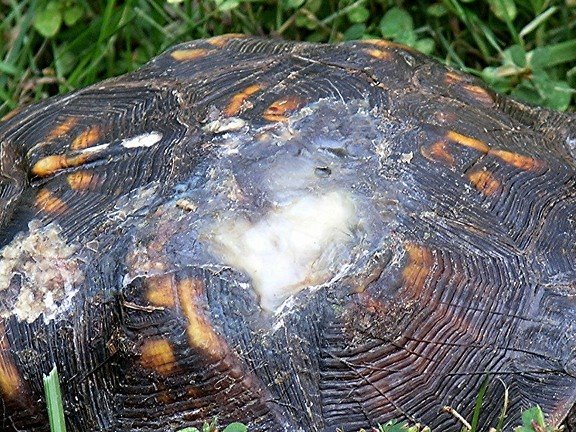
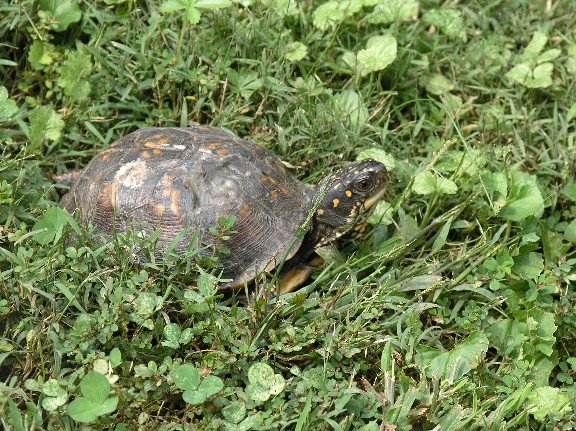
The white Silvodine cream has turned dark gray now, and the shell hole continues to close in. This next series of photos was taken Sept. 23. I'm sure Belle's building bone underneath it too, where she needs it most, over the hole that leads directly into her right lung. First, apparently, a membrane forms, then hardens, and bone builds over it.
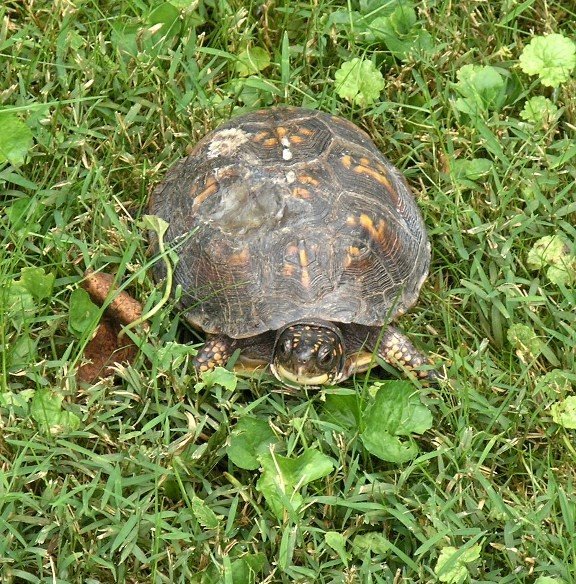
Carol and Gary found two other box turtles in their backyard, and sent this picture of the two, a male (left) and female (right). Shell pattern isn't an indicator of a turtle's sex, other than that a turtle with a whole lot of yellow patterning is likely to be a male. I really dig the marks on the right-hand female's shell, too--like little strongmen holding their fists up. Even eye color can be misleading: red-eyed turtles have been seen laying eggs! By and large, though, red eyes usually denote adult males. This is a male!Belle's a demure, brown-eyed girl.
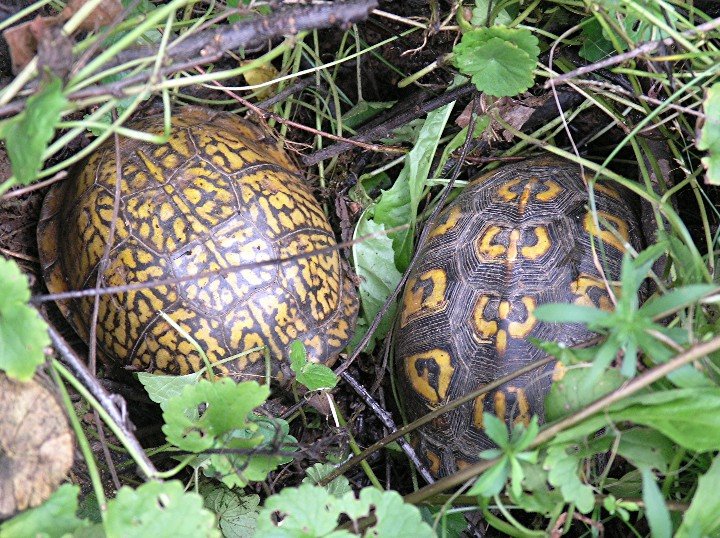
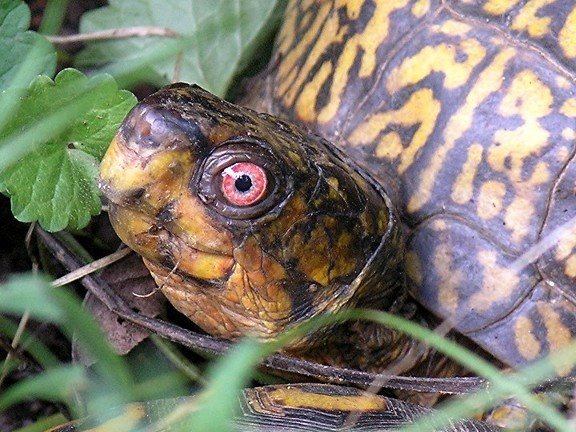
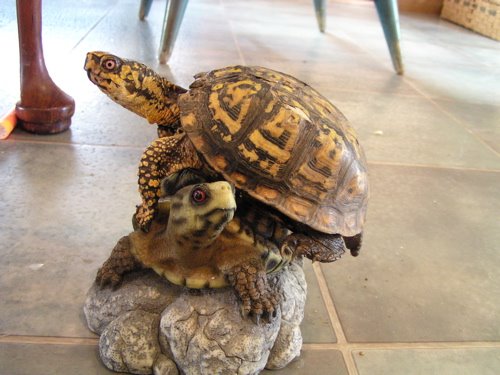
Probably the best indicator of a turtle's sex is the plastron,or lower shell. If it's scooped in, concave, it's a male. If it's flat, it's a female. The male needs a hollow in his plastron so he can balance atop the female. Here's an old picture of Naraht, the turtle who was released here nine years ago after an even worse shell injury than Belle's. He was hit by a car and had to be wired and glued back together. He's still coming around to visit, most recently about this time last September. I always give him a big plate of fruit and mealworms when he comes around the front door, and invite him in for a trundle around the kitchen. Anyway, Naraht is demonstrating turtle mating practices on a lifelike resin statue. Not getting much of anywhere, but he's having fun. Now you know what a horny turtle looks like.
13 Comments:

At 8:02 PM, Blogger MojoMan said...

That's it! I can quit now. I've seen everything. Blow-up dolls for turtles!

But seriously, what a wonderful collection of photos and descriptions of box turtle sex identification and the wonderful variety of shell patterns they can have. Thank you!

Barring cars, mowers, etc. how long can a box turtle live?

 
At 8:22 PM, Anonymous Anonymous said...

Great! Now I can identify a male or female by the shape of the shell and coloring. I've rescued so many of these men and women (from the jaws of my own dog once) and wondered the gender.

The last photo was good for a guffaw :) Only you...

Again, how long do these turtles live?

P.S. Borders in North Charlotte displays your book just inside the entrance, front cover forward!

 
At 9:57 PM, Blogger Susan Gets Native said...

Wow...your blog is so full of sex. Who needs dirty websites?
Turtles, dragonflies...everyone is getting more than me.
;-)

 
At 10:11 PM, Blogger LauraHinNJ said...

I love to see the different shell patterns, too.

Took me a minute to *see* the strongmen with their arms up, but yea, that's it.

 
At 10:47 PM, Anonymous Anonymous said...

My mother used to have a fairly primitive robin sculpture in her garden, but it was realistic enough to fool an adolescent robin one summer. What looked to be a young, inexperienced robin started courting it. It was somehow sad and yet funny at the same time to see the poor dumb robin singing it's little heart out at the statuette. (Though I don't know anything about bird behavior, and the robin might've been cussing the statue out for being on it's turf.)

The turtle, however, is pure comedy gold.

 
At 6:08 AM, Blogger Julie Zickefoose said...

Box turtles have been found with dates and initials carved in their shells as long as 138 years earlier. When I was visiting Martha's Vineyard one fall, a turtle was found bearing initials that had been carved over 130 years earlier by an ancestor of the people who still owned the farm. For all I know, it's still eating black raspberries on the same farm. Lucky turtle. I have a fascinating paper in my files about centarian-plus box turtles that are found and re-found along railroad tracks in New England, bearing dates and initials of train conductors who were known to travel those rails and leave their (cruel but enlightening) mark on these defenseless animals.
Whenever I speak about box turtles I ask people this question: Think about a given one to five-acre plot of land that you know. This is the average home range of a box turtle. Now, has that plot changed ownership in 130 years? Has it been clearcut? Grazed? Burned? Bulldozed? Developed?
For many people, thinking about this question is the way that the box turtle's extreme plight first becomes apparent to them. Boxies are homebodies. And they can't get out of our way fast enough.Very lucky, very rare is the turtle that can live out its natural life span on a protected acre or two.

 
At 6:38 AM, Blogger MojoMan said...

Thanks for the information on box turtle longevity, Julie. It makes me wonder if any of the turtles I collected as a little kid are still hanging on in some small corner of a development somewhere. I'd love to see a story about the 130-year history of a 5-acre plot of land as seen through the eyes of a box turtle.

 
At 8:36 AM, Blogger Lynne said...

What beautiful creatures. The colors and patterns of their shells remind me a bit of agates. There seems to be alot of inteligence shining out of their eyes.

 
At 9:05 AM, Anonymous Anonymous said...

Thank you, thank you!! A private painting instruction, books in the mail and an update on Belle. Could this morning get better? Why, yes, yes it could. Julie in regards to your post on the changing of Iowa farms and the trucking of animals, I thought you and others might be interested to know that the Humane Society of the US petitioned the USDA last fall to apply the "28 hour law", the oldest federal animal welfare law, that passed in 1873, regarding animals transported by rail, to apply the law to animals transported by trucks. The law requires that animals be offloaded after 28 hours so that they may rest, eat and drink for at least 5 hours. The livestock industry has long attempted to keep the law from being enforced for truck shipments. Yesterday, the USDA agreed with HSUS that the 28 hour rule should be applied to trucks also. The HSUS notes that 95 percent of all animal transport is now by truck. So hopefully, a little more humane treatment for our farm friends.

Christine
Takoma Park, MD

 
At 9:03 PM, Blogger The Swami said...

Well! I certainly know it when I see it. And that last photo is definitely hard-shell porn.

I cannot look. I cannot look. I believe I'm about to have the vapors......

 
At 7:40 PM, Blogger janet said...

Such a rich entry!

Box turtles: We had a "pet" box turtle when I was a child (a LONG time ago). It simply moved into our house for a couple of years, ate cat food from the cat's dish (alongside the cat!), hung around the screen porch, and then wandered off to someone else's yard. I saw it years later walking down the sidewalk about a block from our house.

Turtle sex - well actually tortoise sex: One of my favorite memories of the Galapagos is the sound of mating giant tortoises. Watching animals that big humping was amazing too, but the low moaning sound is what haunts me to this day.

mojoman's book idea: Sounds like a combination of John Hanson Mitchell's Cermonial Time, which chronicles 15 thousand years on 1 square mile of land in Littleton, Massachusetts, and Verlyn Klinkenborg's Timothy, or Notes of an Abject Reptile, which tells the story of the tortoise who lived in Gilbert White's garden from the tortoise's point of view. (That's Gilbert White of Natural History of Selborne.)

BTW, your book is displayed front cover forward at Jabberwocky, an independent bookstore in Newburyport, where I bought it this afternoon. I particularly like page 46, of course.

 
At 10:00 PM, Blogger MojoMan said...

Wow..this is getting deep, as in deep map. While I was thinking of William Least Heat Moon's "Prairyerth" when I imagined the 130-year life of a turtle on a single 5-acre parcel, I was also thinking of "Ceremonial Time," a book that took me to some very dreamy places. And, just last night, I learned about Gilbert White in Chet Raymo's "The Path." Cosmic!

 
At 8:32 AM, Blogger Patrick Belardo said...

Somehow the resin turtle has a distinct look of "What the heck are you doing?" on its face.


Post a Comment

<< Home