White Safari
I love Mary from NC's name for the last post: White Safari. Indigo Hill continues to enjoy snow cover that the rest of Washington and Athens Counties lacks. I love it, though I haven't been able to get out today, and it's driving me nuts. I'll just have to go out in photos. As promised, I'm going to post some more tracks from my last foray. My guide in this has always been the late Olaus Murie's Field Guide to Animal Tracks, published by my own Houghton Mifflin, source of all good things in natural history. I love this book because it's written by a real, suspenders and plaid-wearing woodsman, who could read what he saw in the snow and mud. He's got different patterns for different gaits, and he drew them all himself. What more could you want?
Here's the thing about tracking: The closer and longer you look, and the more you think about what you see, the more is revealed to you. It may seem like magic, but if you just wait for it to come to you, the animal's motivations and actions reveal themselves in its footprints. Little smears and blurs can mean something. You can tell how fast the animal was going, and sometimes what was chasing it.
Cottontail prints are hard to misidentify; that oblong, heavily-furred rear foot is unique. Bunnies do a lot of squatting and shuffling on their butts, so their tracks are often clustered. They also sit in one place for a long time, so you can find melt marks and body prints.
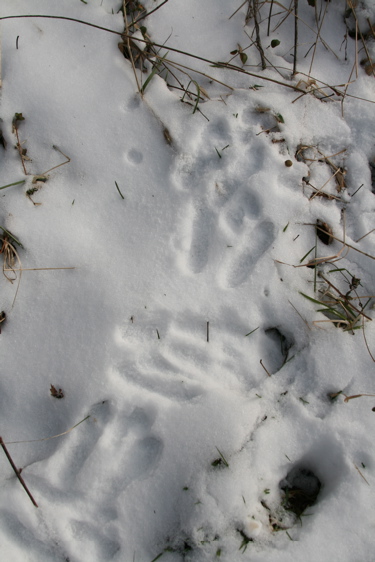 Where there are bunnies, there will be other animals, particularly those that enjoy dining on them. Right by the bunny prints were some beautiful fresh mink tracks.
 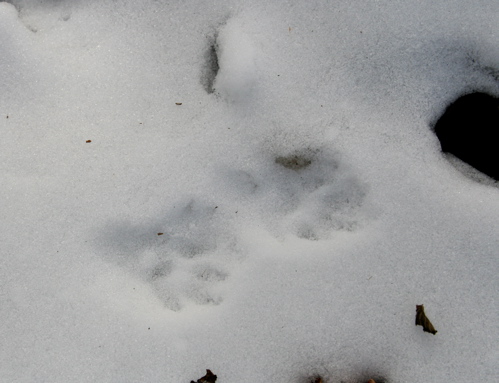 I was delighted to find them, and to know we've still got mink. I'll never forget the summer morning soon after we moved here in 1992 when we saw a very bedraggled rabbit come loping out of the meadow into the yard. Bill and I were watching it, and I remember commenting, "That rabbit ain't right." It was listing from one side to another, the fur around its throat matted and wet. And not long after it emerged came a gorgeous ebony-brown mink, humpety humping along on the rabbit's trail. Neither of them looked to be in a particular hurry, but they'd probably been running in circles for a long time. They wove in and out of the tall grass. Eventually we heard the squeal that told how it ended.
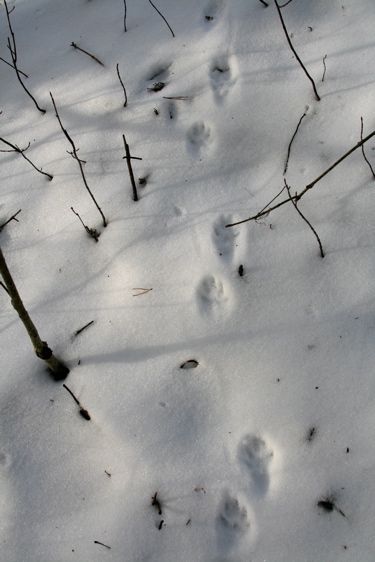 Mink tracks are typically in pairs, with forefeet landing in or near the hind foot tracks. The span between pairs is about 8-10". The hind foot is longer; the forefoot is rounder. In this photo, you can see drag marks from its tail, appearing as straight swipes parallel to the tracks. Love it!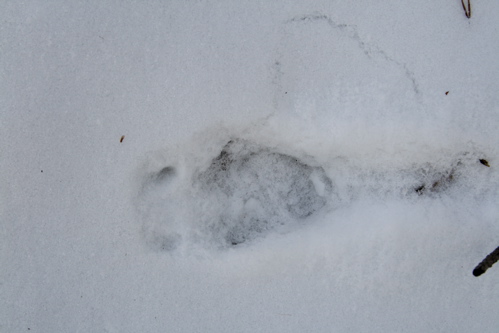
It takes snow or mud to see the dew claws on a deer track. Big, heavy buck tracks show dew claws more often than do those of the lighter does. This animal was sliding down a little incline. I'm always amused at how much slipping and sliding deer do. Where I tend to fall on my ass, I see that the deer have, too. We use the same trails and cut-throughs. And this is a slippery old ridge.
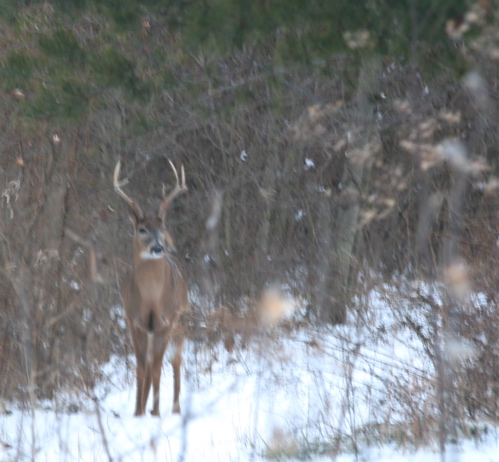
I've started putting corn out now that the weather's finally gotten cold, and glory be! a couple of does and this gorgeous buck came out to sniff around. I've seen a lot of bucks, some more impressive or magnificent than this one, but I think he's the prettiest ever. His rack is so tall and proud, it looks like he's wearing a crown. The brow tine on his right antler is just a nubbin, so he's probably a seven-point buck. Good of him to hang onto those antlers this late into January, so I could admire him. This, taken through double-pane glass in a snow squall at dusk, is the best I could do without frightening him off. After what seemed like the longest damned hunting season in the history of Ohio, even the bloody muzzle-loaders are silenced now, and I'm happy to know that he (and I) can relax and wander in peace on our land. I'll be watching for him come velvet time, in June. And saying a little prayer that he knows when to lay low.
 Beauty comes quietly, when no one is particularly watching for it.

posted by Julie Zickefoose @ 6:10 PM





<< Home