Biting the Bullet for Swallows and Bluebirds
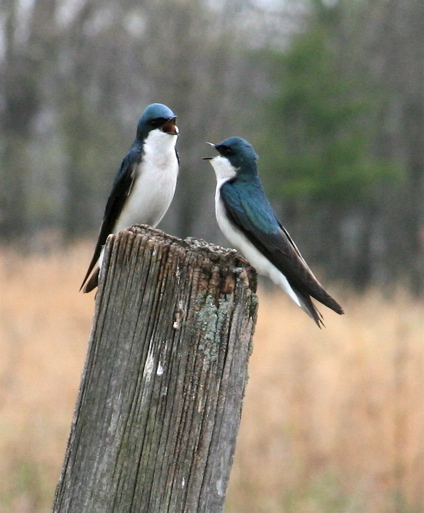
I don't have a great big long lens--only 300 mm, handheld. What I do have is ridiculously tame tree swallows. Think they know who got rid of the house sparrows in their box? You bet they do. The female won't even budge off her eggs when I open the box. I have to lift her up to count them.Nothing good comes without passion and hard work, I think. Well, duh, I don't think that. Lots of good things happen unbidden. Sure they do. But if you want nice birds nesting in your boxes, and you have a plague of house sparrows around, you've got your work cut out for you.
We don't usually have house sparrows around this place. But last spring I wanted to paint a brood of baby house sparrows from life, and I figured it was worth letting them nest in a bluebird box, just this once, for the painting. It's a great painting. It was worth it. What I didn't bet on was that when that brood fledged, the pair would sneakily set up a second brood in our big bluebird roost box, which can't be opened, and raise that one, too. Before you knew it we had nine to fourteen of the freakin' things chirrupping around here every morning, stuffing themselves with suet dough, and stuffing the bluebird boxes with weed stems and feathers. Oh, man, what a bed I made for us.
So I went rummaging around in my bluebird supplies in the basement and garage and miraculously found a small white sealed envelope. I opened it up and found a Gilbertson in-box sparrow trap. What are the odds. I didn't even know I had it; I was looking for the Huber in-box trap I had years ago and have since misplaced. Nothing's ever truly lost when you own as much krap as we do; it just gets covered over. Steve must have sent it to me as a gift when I ordered the last case of 14 Gilbertson PVC bluebird boxes from him. Not only is he a genius, he's a really nice guy, too.
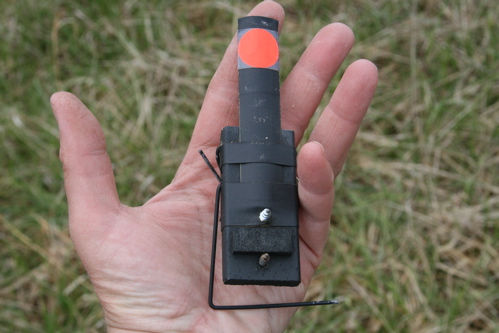
This has to be one of the neatest and best little inventions ever, made by my friend Steve Gilbertson, he of Gilbertson PVC bluebird box fame; he of the Gilwood box (a fabulously well-designed wooden bluebird nest box). It's simple, but man, does it work well. You mount it with a couple of screws on the inside front door of the box, so when it's tripped, the little tongue of flexible but strong plastic flips up and covers the entrance hole. The treadle, which looks like a wire L in this shot, hangs down over the nesting material, and the bird lands on it when it enters the box. Here , the trap is set, ready to spring when I close the box and a bird lands on the treadle.
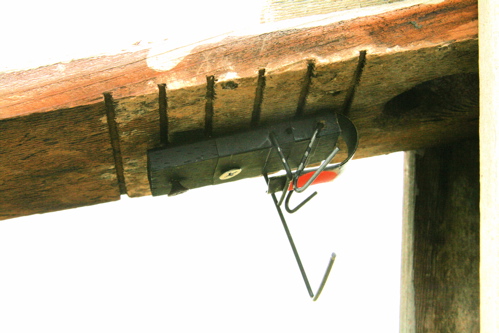
When you see the orange dot in the hole, you've got a customer inside.A trap like this is non-specific; it will catch whatever bird enters the box. But neither does it hurt the bird. The only thing you must be sure of is that you check it frequently, at least every three hours. I check it every half-hour. I've caught a bluebird and a Carolina chickadee this week, and they were only confined a matter of minutes before I ran up to release them. I've also caught seven house sparrows in two weeks. They were not released.
I've made dozens upon dozens of trap runs to four different far-flung bird houses on our property, but it's been worth it. We're down to one male house sparrow on the place, and he's real lonely. I hope he'll bug off soon. Why do I do it? Because the house sparrow infestation is a problem of my own making, one that threatens to negate the 15 years of good work building bluebird and tree swallow and Carolina chickadee populations on our farm. If I let them reproduce in my boxes, before long all I'll be producing is house sparrows, an imported Eurasian species that kills native nesting birds. And I do it so, instead of a scruffy house sparrow, I can see this sitting on my bluebird boxes:
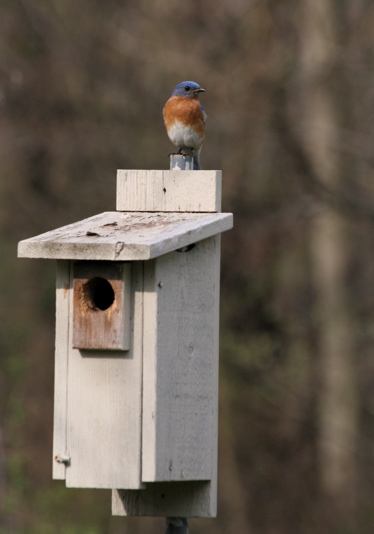
And this sitting on the perch post beside a box where I've trapped two house sparrows:
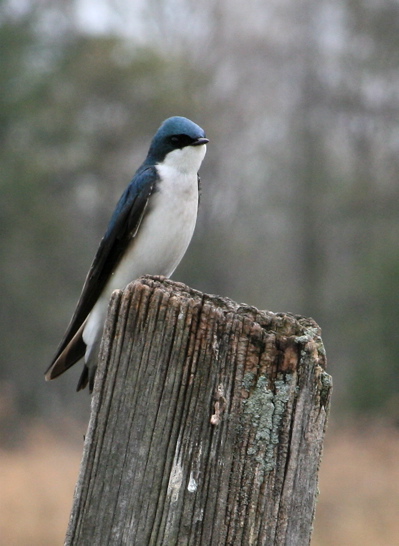
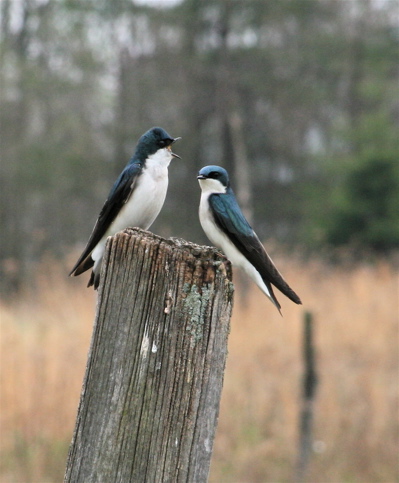
And the lovely tree swallow and his mate, having an animated conversation about the new house that just opened up. This may be the only kind of bigotry that's really justifiable.
Labels: bluebirds, Gilbertson trap, Steve Gilbertson, Trapping house sparrows, tree swallows


47 Comments:
Hi Julie,
I am home in Newfoundland and this time I brought my binoculars! Today, right outside the kitchen window I was rewarded with pine siskins, a red crossbill and, I think (though it requires more sleuthing since it shouldn't be here), a white-breated nuthatch. My mother-in-law says there are also American goldfinches and a Northern flicker, so I'll keep my eyes peeled, despite the ancient and beloved border collie's attempts to scare all the birdies away.
Sara
I'm so grateful that we don't have House Sparrows in my area. I saw so many on our camping trip over Spring Break. But, they aren't in my neck of the woods. Yet. Hopefully they'll stay gone a good long time.
You really need to explain how you 'dispose" the house sparrows. I have never found a good way.
Delicacy demands that I get your e-mail address, lectric lady. If you don't wish to leave it here, you can email my online comment box at my web site, www.juliezickefoose.com, and I can get your email that way.
I monitor over two dozen boxes and I regret having to trap the house sparrows. I wish they would stop with the killing. I actually kind of like them sometimes. Like when I see them go into the wheel wells of cars at the shopping center in winter to keep warm or when I see them inside my local home center. I read a book called Providence of the Sparrow where a hand raised pet House Sparrow is very endearing. I've killed six sparrows so far, 4 last year and two this. I caught them with a similar trap - the van-ert trap. I feel bad doing it even though I think it's necessary in order to have bluebirds, tree swallows and chickadees.
I love what you write..but I must mention this.
I'm sure that you're not re-homing the English House Sparrows that you catch in your traps. That is fine, I've no problem with it. I can't do it, but more power to those that can.
Yet, in a previous post...you talk about Lily of the Valley. A non-native, invasive species that does the same thing to native species of plants that English House Sparrows do to Bluebirds and Chickadees. April
Hey, Julie...send those room temperature HOSP our way! Our peregrine and Coops would love them!
Kathi got 5 of them, generously donated them to RAPTOR and our bird eaters have thoroughly enjoyed dining on fresh HOSP.
Some people can't see the wisdom and necessity of getting rid of HOSP. All they can say is "Those poor birds." But humans brought them here, and it's up to humans to, if not decimate, control their population.
I'm surprised that you even see HOSP at Indigo Hill. Bit far out in the boonies, but it just shows how pervasive they can be.
I have the girls on the "No House Sparrows" bandwagon. Isabelle says to me all the time, "Mommy, those house sparrows would be prettier in England." That's my girl.
This is such a difficult and controversial subject for me. For a long time, I resisted the advice to remove sparrows in order to protect bluebirds. I didn't disagree with those who practiced lethal control, but felt I just couldn't do it myself.
After witnessing the damage a HOSP did to my bluebirds, I am now trapping and removing house sparrows, but I am still very uncomfortable with the whole process. Donating the bodies to RAPTOR helps me come to terms with it.
I have 3 male purple martins here now (2 ASY, 1 SY) and as soon as they discovered the gourd rack and began investigating cavities, along came 2 starlings who ran them out. I set my insert traps for the SuperGourds and got the starlings almost immediately. I hated the whole thing, but later in the afternoon, a martin was loafing on the rack and another was singing from within his gourd, calling for a mate. It is worth the agony to hear that song and to know I am helping a beneficial native species.
Susan: We'll have to do a bird deal again soon.
~Kathi
I have one trying to nest in my second bluebird house an I just keep removing the nesting material. I've removed it four times already...sigh... I need one of those traps too. I agree, it's about population control and for that reason, I can justify doing away with them.
Dear April,
I've never seen lily of the valley escape, though with its vegetative propagation I'm sure it could. Mine is confined in a raised block bed with mown lawn all around it, and it has taken four years to get to the point where I can even separate enough to give away.
In the last two days, I've hand pulled over a hundred yellow rocket plants from our meadow and orchard. I'm careful about invasives, careful enough to pour Roundup on two gorgeous clumps of Miscanthus grass (M. gracillissimus "Morning Light") that started throwing seedlings, and to pull buddleia by the fistful, and to keep a zero-tolerance stance on lavatera, garlic mustard, yellow rocket and any exotic grasses. I'm fighting creeping Charlie and losing. So far, lily of the valley has not been a problem here, but thanks for the warning.
Every year I resolve to be prepared, but it's happened again! The hummingbirds are back and my feeder isn't out! I always apologize to the little guys hovering at the window, trying to get my attention. I'm sure you're seeing them too--but just in case,...they're headed your way!
I was right that a white breasted nuthatch shouldn't be in Newfoundland -- the bird came back this morning and is an orange breasted nuthatch, a female with a very pale orange breast. It keeps getting closer and closer until it's bullied away by a junco.
Yeah, Sara! A red-breasted nuthatch, one of my favorite birds. Did not know you were from The Rock! I've spent twelve weeks there in two visits and love it. Cape St. Mary's, Hare Bay...I've even kissed the cod and chased it with a belt of Screech. Which makes me want to puke--the rum, not the cod.
I'm so glad I've only ever seen one house sparrow at my feeders, and he never came back. We have a few bluebird pairs, but I'm only beginning my efforts to usher them onto our property.
It's a tough job, but you seem to be doing it well! Congratulations!
Stirred the pot didn't you?
Since when is a 300 lens small? I just have my cannon point and shoot
RR
Hi Julie,
I ordered a Gilbertson sparrow trap this year. I installed it into an old bluebird box and hung it on my wash line post.
It worked almost instantly and in a matter of minutes the bluebirds were building their nest.
I've been able to trap about 6-7 sparrows. I feel no guilt, there are still many flying around my place. If they start pestering the bluebirds, I get out the trap house.
It sure is worth it to have nesting bluebirds in my back yard.
So far I haven't been troubled by House Sparrows, although seeing a pair at my seed feeder a few weeks ago had me thinking "there goes the neighborhood."
My biggest problem is with House Wrens poking holes in the bluebird eggs, throwing them out, and piling twigs on top of the bluebirds' nests. This in spite of the presence of four count em four wren houses placed well away from the bluebird boxes. Luckily, my E. Box Turtle, Junebug, loves wren eggs.
I cannot justify killing any creature ... not even for the sake of another.
Nor can I justify interfering with wildlife. The wild is meant to be wild.
Sorry, but that's the way I feel.
Actually, I'm not sorry.
Janet
Yes, well, screech is pretty bottom of the barrel stuff -- literally. We're much, much better at beer. I only get home to sample it once or twice a year -- and next time I am going to Cape St. Mary's!
Dear Janet,
If managing bluebirds and tree swallows (to the tune of 70 baby bluebirds fledged from boxes on my farm each year) is interfering with wildlife,and keeping the wild from being wild, then so be it. I am a big interferer. I have a mission to increase the populations of these nestsite-limited native birds, and this is how I do it: by interfering.
I respect and understand your regard for all life. I have found that people who feel as you do about the sanctity of all life rarely wish to get involved in the kind of hands-on, down-and-dirty wildlife management I do. It raises difficult issues, and it would be a whole lot easier to "let the wild be wild" and not put up bird boxes at all. But taking this attitude in managing my bluebird boxes--something I'm deeply committed to doing right-- would mean that I'd be raising an incredibly aggressive exotic bird in boxes that I mean to be occupied by native birds. Eventually, I'd have to abandon my 15-year effort to make bluebirds and tree swallows a commonly seen species around my home, and the routes I travel. That would be a real loss to this community, and the native avifauna we enjoy.
I take absolutely no joy in eliminating house sparrows. It's part of the package with promoting the population growth of bluebirds, Carolina chickadees, tufted titmice, and tree swallows.
Ruh-roh, Catbird, I think we need to back up a bit. House wrens, unlike house sparrows, are a protected native species just like bluebirds and tree swallows. Years ago, I checked with the Bird Banding Laboratory to be sure of how to legally deal with them. Briefly, it boils down to this: It's OK to throw out the sticks the male wrens put in boxes when they're making the so-called "cock nests"--jumbled collections of sticks that they stuff every cavity with in order to attract a female wren. But once the female wren arrives, makes a nice grass lining in one of the stick nests, and lays her eggs, it is illegal--and unwise--to disturb that nest in any way. Quite apart from following the letter of the law, which I recommend, there is an even more compelling reason to leave nesting wrens undisturbed. If you take their eggs, they will go to the nearest bluebird box and throw out the bluebirds' eggs on the very same day. I refer to nesting house wrens as "powder kegs," ready to go off at the slightest provocation. And taking a house wren's eggs is a very big provocation. My recommendation is to check your boxes, and when you find a grass lining and wren eggs in one of them, it is then safe to remove the twigs from the "cock nests" in all the other boxes in your yard. Leave the occupied, egg-filled wren nest undisturbed. Then, and only then, can wrens co-exist with bluebirds.
If you're having that many wren problems, your yard is probably too overgrown to offer good bluebird habitat, anyway. Be sure to site bluebird boxes as far away from shrubbery and woods edges as possible.
You're right. Mea culpa. Now I'll just have to hope the chickadees move back into the box they used last year; they gave the wrens as good as they got.
We had chickadees build a nest in our bluebird box, then something came along and destroyed it! The pole is baffled, so it wasn't a raccoon or squirrel...think it was a wren?
I think the bluebirds skipped over us this year. :(
Catbird:
One more tip on house wrens that I have learned. These tiny little birds lay a ton of eggs and usually double clutch, so the more boxes you put out for them, the more wrens you have, and the more likely they are to take over your yard. Unlike tree swallows and bluebirds, they seem to tolerate other members of their species nesting in close proximity. [I even had a male last year who had two females with nests about 12 ft apart.] Try taking AWAY wren boxes to cut down on the population growth. As Julie says, site your bluebird boxes out in the open, away from prime wren habitat (brushy, weedy areas, fence rows, and edges of woods.) And DON'T toss out the wren eggs. Not only is it illegal, but it makes them vindictive, and they go on the prowl for someone else's eggs.
I don't know if it would help with house wrens, but this Sparrow Spooker idea from the Sialis web site http://sialis.org/sparrowspooker.htm is an excellent tool to keep house sparrows out of active bluebird boxes. I have had great success with mine.
For anyone interested in bluebirds, www.Sialis.org is a great site. It has lots of information about bluebirds, including house sparrow management. There are also some fairly gruesome photos of what sparrows do to bluebirds when you let the wild be wild. Don't look if you can't stand gore.
~Kathi
If I could add a thought to the "interfering" vs. let wild be wild discussion. I'd agree with a hands off policy, if man hadn't already stuck his hand in and sent things so far askew. The native species weren't designed to deal with what we've introduced--nor are they able to restore habitat that man has destroyed. In a perfect world, we could be the observers, but in our imperfect world we should restore what we can. My hope is that someday, wild really won't need us. But until that day...
Dear Maureen,
What destroyed the nest depends on how you define "destroyed." If the nesting material was pulled out of the hole, then a coon or housecat got over your baffle (it happens all the time). If the eggs are missing in an otherwise undisturbed nest, then it has to be either a wren, a house sparrow, a flying squirrel, or a rat snake. (Big rat snakes can get over 24" stovepipe baffles). I'd also throw out the possibility that the chickadee has pulled a layer of fur and plant down over the eggs in her absence. You can see eggs one day and nothing the next--and it's just because she's covered them while she's out. So which is it?
More info for Science Chimp, pleeeze.
Hi Julie,
I'm a volunteer for the local State Park, which encompasses many old homesteads. Gosh..the Lily of the Valley can get out of hand. I've seen it grow under driveways and pop up on the other side, LOL!
It IS a lovely plant, with blossoms that smell wonderful. I like "smelly" plants! But boy oh boy..is it hard to get rid of.
I live in a semi-rural area, so HOSP are a part of my landscape, I *could* kill them all day long, and they'd still keep coming. My purple martin house, for instance, is all HOSP and Starlings. DH is going to take it down this year.
I leave it to my Cooper's Hawks, who perform great feats of predation right in front of me(they're not shy)at least 3 times a year.
I appreciate the efforts of those who control their HOSP populations..I can't do it. I guess it's just a personal weakness on my part, LOL!
I have no problem ripping up purple loosestrife, or japanese honeysuckle!
I do so love it when JZ stirs the pot...even when she doesn't try to.
My take on it:
All life is NOT precious, when a species is introduced and ruins all hope for a native one. Humans have interfered so much, that trapping and killing HOSP is not only important, but a necessity if BB and TRES and any other cavity nester are to succeed.
HOSP will claim a territory and not allow anything else to nest there. You can't give them their "own" nest box.
HOSP will peck at the heads of baby birds until they are dead.
HOSP will kill the adults, too.
HOSP will build a nest over the dead bodies.
This country was never intended to support HOSP or starlings. And our birds suffer.
Everyone is entitled to their own opinion. But sometimes you have to listen to your head and not your heart, when it comes to wildlife. If you want bluebirds and other cavity nesters, you HAVE to practice ACTIVE reduction of HOSP.
Kathi: Let me know when you want to pass off the Raptor Food...and this time, we will not subject your staff to the exchange!
Julie: Keep interfering! The world is a better place for it.
I'm only a beginning bird watcher, but I have seen the incredible beauty of a bluebird up close and kind of personal. These lovely birds and other species need delicate care and protection from compassionate humans. It's required from us. As compassionate as I am with all living things, I would take advice from loving birders I see here on this post and do whatever I need to do... I've terrorized a few house sparrows lately and I hope, for their own sake, they stay in the grocery store parking lots.
Julie, rock on.
On my walk early this evening, I was chided by a newly-arrived House Wren. Word travels fast.
Hey Science Chimp :-)
The nesting material (moss) was pulled out through the hole and I saw bits of it scattered in the yard. I don't know if they'd gotten to the egg stage since we'd only watched them build and I hadn't peeked in the box until the day I went out to check and found the destroyed nest. I checked it this morning and it is still empty except for a lone twig, which I tossed out.
The chickadees simultaneously built in a nearby decorative house that I can only see into by peeking in the hole. It hangs from a thin branch in the maple tree and the nesting material is still in there.
I'd guess 'coons since we relocated 35 last year (people are usually stunned by that number, we have only about 3/4 of an acre). Is there anything I can use in addition to the baffle?
Dear Maureen,
I'd guess 'coon too. Nesting material pulled out of the hole is pretty indicative of their work. Although a housecat will do that too. Coons can't jump, but cats can, and they do their work from the top of the box. Either one pulls nesting material out of the hole in the process. Sounds like a candidate for relocation. With 35 caught, I'm wondering if you're taking them far enough away--you may be getting some returns.
The 24"x 7" galvanized stovepipe baffle I recommend is only effective as long as the animal doesn't know there's a prize at the top.Having once been rewarded, the coon that wrecked the chickadee nest is going to be a problem forever more. Make sure the baffle is mounted right up under the house, that it's at least 24" long, and that you trap the offender and take it at least 3 miles away (the farther the better).
I am not a proponent of hole-mounted so-called "predator guards." I believe in keeping the predator off the box altogether.
Nor am I a fan of decorative bird boxes. They're hung for decoration, but all too often, birds nest in them, and there's no way to open them up to help if there's a problem. Nor is there any way to clean them out between nestings. Blowflies and feces, blaaah. Or wren twigs. Either way, they're quickly rendered unusable.
Did anyone notice that in the last picture, the female really LOOKS like a female? Like a Disney-drawn female bird? She even has eyeliner!
Regarding HOSP and the accusation about them "building there nests on the dead bluebirds(!)" I have used this line myself but I don't really think this is a fair point or a reason to be outraged and go after the sparrows. There are other good reasons to manage HOSP. It's normal for wild birds to fight over cavities and I don't think that it's because out the native birds are more enlightened that you don't see the sparrows dead. I don't think they can for some reason. I wonder if the sparrows could remove their victim physically if they would. Male House Sparrows are quite hansom in there way. If for some reason House Sparrows were suddenly almost wiped out I would encourage the use of nest boxes to help them. Prob. not in north America though.
I went directly from reading this post to the zoo where I'm volunteering, and the HOSP there are a nuisance! They are everywhere in and around the enclosures (because of easy access to food) and are squabbling so noisily over nest sites/mates that we could barely hear ourselves speaking. Here's how bold they are: I watched one male sparrow in the Great Horned Owl enclosure, tearing strips of bark from a tree trunk, and then carrying them up to the top of the mesh ceiling of the Barn Owl's neighboring enclosure. There was already a substantial nest there...will keep my eye on it to see if the owls continue to tolerate their presence!
Thanks Julie - I'll move our trap closer to the nesting box and put some wet food in it. Surely a nice meal of easily accessible smelly wet cat food is more appealing than all that pole work for a few bird eggs. :-)
It could be a cat but I've not seen any lurking for quite a while. The neighbors who have them are keeping them in after realizing that I have no qualms about trapping Fluffy or Mousebreath and handing them over to Animal Control. Even the hate letter circulated through the neighborhood by the nutball next door and her 2am phone calls didn't deter me, so the cats are scarce.
I do see 'coon droppings around, however. Animal Control lets us drop them off in the woods behind their facility and it's nearly 10 miles from here. I think the number is due to the decimation of a lot of woods around here. They see our backyard and think "cool!" but then proceed to cause a lot of damage so the ones that venture up to the house tend to wander into the trap and they go for a ride.
Is it possible it's a squirrel? We have some real jumpers. I've not seen one on the nesting box, but don't watch every minute. Would putting it on a taller pole help? Or would birds reject it? It's at the current height (around 4.5 feet) I'd seen recommended.
I should mention our decorative houses are functional in that they are cleanable and I clean them out when the birds move on (the roof or floor of any of them pop off or unscrew), but they aren't the "easy-access" for viewing like the Gilbertson box, so I can't peek in.
I read this somewhere and found it deeply ironic...English House Sparrows and Starlings are becoming scarce in Europe! Would that we could find a way to send them all over there.
About the only thing I can do is try to find seed mixes that HOSP don't like.
Squirrels nest in my bird boxes. They enlarge the holes with their teeth, and voila! Happy squirrel!
Everything but the birds I want nest in my nest boxes. That's why I want to buy 40 acres and a mule out in the middle of nowhere!
I noticed, whilst traveling last October, that there don't seem to be many HOSP or Starlings on the East or the West coasts. Am I wrong? I just didn't see hardly any....
April
Julie,
I am battling hosps in my yard/garden in WV. Last year, I literally cried when I found a dead female tree swallow that had been bludgeoned to death by a hosp in a box. This year, I waited to install two boxes until the hosps had begun building their nests and bonding to specific boxes. I also successfully used monofilaments to deter hosp from two of my four boxes. I'm pleased to say that I believe the tree swallows have bonded to a box but they are taking their time in building their nest. Do you know how long it typically takes for a tree swallow pair to construct their nest (I know the female usually builds the nest)? I've witnessed them mating and they've left some strands of grass in the box but definitely haven't been working as diligently as a robin, mockingbird, hosp, etc. does when constructing their nests. Any ideas?
Kindly,
Molly
Dear Molly,
Give the tree swallows plenty of time. They are only just getting going in so. Ohio, only just building their nests. They must wait until there are plenty of flying insects and the nights have warmed up before committing to eggs.
I sense that you are trying to allow both house sparrows and tree swallows to nest in your boxes. Perhaps you are too soft-hearted to trap the house sparrows. You should never, ever let house sparrows proliferate in your boxes. You may as well take the boxes down if you let sparrows nest there, because next year there will only be a bigger problem for the swallows and bluebirds. Please visit http://www.nabluebirdsociety.org and look under Catalog and then Traps and order some Gilbertson in-box traps. Get rid of those pests if you ever wish to have tree swallows survive in your boxes! And driving them a couple of miles away is NOT sufficient! They have wings and tend to use them!
Best wishes, and I hope you'll take my admonition in the spirit in which it's meant--truly helpful, not meaning to insult.
Julie,
Thank you for your information. I am, indeed, too soft-hearted. I certainly understand the importance of riding an environment of invasive species. However, I also wonder how/when an invasive species eventually becomes noninvasive and is considered a natural component of an ecosystem. As with most birders, I value bluebirds, tree swallows, etc. more than hosp. Hosps aren't enjoyable audibly, visually, etc...we all know that. But, I can't help but wonder when does "survival of the fittest" become the standard. I am definitely tampering with my small yard niche and part of me wishes that I had the mental and emotional strength to kill the hosps...I just don't have it in me. But, I guess my overarching question is what I asked earlier...how/when does an invasive species transition to become accepted as a natural element of an ecosystem? Food for thought...especially given that hosps were introduced approximately 150 years ago.
Also, the most recent newsletter from the University of Cornell draws interesting correlations on the success of hosp populations and house finch populations. Go house finches!
As a side note, my husband purchased a trapping mechanism for the feral felines in our area. I am going to take them to the pound as they are attacking the birds at my feeders.
Btw, I am a "new" blogger and have enjoyed your blog. You've given me much to consider.
Kindly,
Molly
Dear Molly,
You raise an interesting point, one I've thought about a lot, too. Invasive species are here to stay. But I think it's important to make a distinction between a natural ecosystem (where bluebirds might nest farther inside the woods to get away from HOSP pressure) and a highly artificial one (a backyard loaded with bird boxes). I think of the backyard as kind of a supernormal situation--abundant nest cavities, very close together. You draw lots of cavity nesting birds into a small space with this supernormal stimulus. They are put into direct conflict with each other. In essence, you've built a ring where HOSP and EABL are forced to fight it out. And so you see the murderous nature of the HOSP wins out every time. It will never become a natural component of an ecosystem because this is not an ecosystem; it's an arena of great and unnatural conflict. It's not good for bluebirds. In my view, as creator of this highly artificial situation, you owe it to the native birds to fight for them, if you wish to encourage their nesting.
Allowing house sparrows to proliferate is not beneficial in any way. There's no native bird that will peck in the head of a bluebird, tree swallow, chickadee or titmouse. Only house sparrows do that, and they will always do that. They're not going to mellow out with time and evolution. This strategy works for them. So it's up to us to decide whether we want more of them in the world. I've decided that I don't. I DO want more native cavity nesters. And so I make the hard choice and do the hard thing--trap and eliminate the house sparrows. It gets easier with time and experience, but it is never enjoyable.
Best,
Julie
Julie,
Seeking your advice/thoughts again. This evening I heard noise outside my kitchen window and saw two tree swallows "battling" in the air and tumbling to the ground. Okay...so I've definitely witnessed their acrobat courtship flight but this was different b/c there was a third bird. Unfortunately, b/c I witnessed the event in the middle, I couldn't determine which birds were "my" residents. After tumbling to the ground, one bird (also couldn't tell if it was male or female) had pinned the female on the ground. THEN...a male tree swallow landed on top of the other swallow. So, there was a pile of three on the ground. The female on the bottom was on her back, I couldn't see the middle bird, and the one on top had his wings extended and kept the two pinned for 1-2 minutes...he was seemingly mating. Immediately afterwards, my residents were on the telephone lines mating. My understanding was that tree swallows mate for life and are monogamous. Is that not true? What was occurring this evening? The female's features were ruffled and she definitely wasn't her perky self. Instead of flying, she spent the next 15-20 minutes resting on the telephone line (with the occassional brief flight)...she wasn't preening...just resting. Thoughts?
Kindly,
Molly
Julie, my husband and are are reading your swallow information with dread, hoping for some information to help us. Our neighbors across the street put up a massive "artsy" birdhouse, multi-holed, maybe four or five feet across, and it has become a bird "project" full of battling, noisy, messy, invasive house swallows. They have already made a hole to get into my attic, so we had to get an exterminator. Do you have any recommendation? Is it a health department issue? These people are not going to get rid of this massive bird house, and as long as it's there, we are going to be tormented with swallows. It is so noisy in the mornings, you can't even talk. And all the other birds are disappearing. No other bird song can be heard anymore.
Julie,
I wanted to follow-up on our hosp issue in our yard. Instead of terminating the lives of the living hosp parents, we tossed the eggs in both bird houses. Both sets of couples deserted the boxes and my tree swallows successfully raised and fledged 4 babies. Just wanted to let you know that tossing the eggs caused the hosp to completely desert and there were no attacks on my tree swallows. Perhaps removing the eggs is easier for people with aversions to directly terminating living hosp parents.
Molly
runescape money runescape gold runescape money runescape gold wow power leveling wow powerleveling Warcraft Power Leveling Warcraft PowerLeveling buy runescape gold buy runescape money runescape items runescape gold runescape money runescape accounts runescape gp dofus kamas buy dofus kamas Guild Wars Gold buy Guild Wars Gold lotro gold buy lotro gold lotro gold buy lotro gold lotro gold buy lotro gold runescape money runescape power leveling runescape money runescape gold dofus kamas cheap runescape money cheap runescape gold Hellgate Palladium Hellgate London Palladium Hellgate money Tabula Rasa gold tabula rasa money lotro gold buy lotro gold Tabula Rasa Credit Tabula Rasa Credits Hellgate gold Hellgate London gold dofus kamas buy dofus kamas 血管瘤 肝血管瘤 音乐剧 北京富码电视 富码电视 富码电视台 7天酒店 7天连锁酒店 7天连锁 自清洗过滤器 过滤器 压力开关 压力传感器 流量开关 流量计 液位计 液位开关 温湿度记录仪 风速仪 可燃气体检测仪 wow power leveling wow powerleveling Warcraft PowerLeveling Warcraft Power Leveling World of Warcraft PowerLeveling World of Warcraft Power Leveling runescape power leveling runescape powerleveling
runescape money runescape gold wow power leveling 棕榈树
eve isk
eve online isk
eve isk
eve online isk
runescape money runescape gold runescape money runescape gold wow power leveling wow powerleveling Warcraft Power Leveling Warcraft PowerLeveling buy runescape gold buy runescape money runescape items runescape gold runescape money runescape accounts runescape gp dofus kamas buy dofus kamas Guild Wars Gold buy Guild Wars Gold lotro gold buy lotro gold lotro gold buy lotro gold lotro gold buy lotro gold runescape money runescape power leveling runescape money runescape gold dofus kamas cheap runescape money cheap runescape gold Hellgate Palladium Hellgate London Palladium Hellgate money Tabula Rasa gold tabula rasa money lotro gold buy lotro gold Tabula Rasa Credit Tabula Rasa Credits Hellgate gold Hellgate London gold dofus kamas buy dofus kamas 血管瘤 肝血管瘤 音乐剧 北京富码电视 富码电视 富码电视台 7天酒店 7天连锁酒店 7天连锁 自清洗过滤器 过滤器 压力开关 压力传感器 流量开关 流量计 液位计 液位开关 温湿度记录仪 风速仪 可燃气体检测仪 wow power leveling wow powerleveling Warcraft PowerLeveling Warcraft Power Leveling World of Warcraft PowerLeveling World of Warcraft Power Leveling runescape power leveling runescape powerleveling
runescape money runescape gold wow power leveling 棕榈树
eve isk
eve online isk
eve isk
eve online isk
Play Roulette for free as often as you like, get a feel for the game and how to place you bets.
Free Roulette is a great game with many ways to bet so learn strategy and have fun.
Roulette is a casino and gambling game named after the French word meaning "small wheel".
The roulette wheel is believed to be a fusion of the English wheel games ... The American style roulette table with a wheel at one end is now used in most casinos.
Is a Free Roulette Systems 100% Effective Or Should I Pay For One?
They are a dime a dozen, but there are only a few
roulette strategies that really work. Also I think it is great if you
can find a Winning Roulette Systems, because these roulette systems really do beat the wheel time and tiem again.
Post a Comment
<< Home