Good New Is, The Bluebirds Hatched...
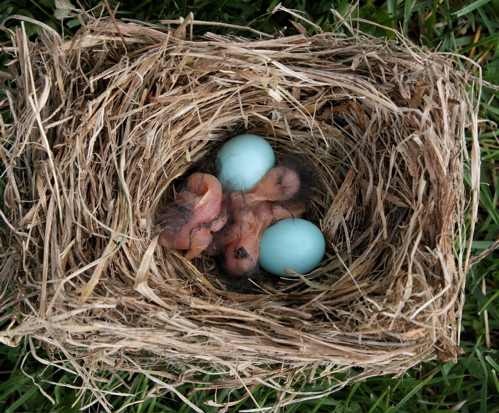
I've had a lot of e-mails about the five bluebird eggs in my front yard box, which were due to hatch April 12 or 13. Short answer: Yes, they hatched, at least four of the five did. There's also a long answer, as there usually is here in my little laboratory, where natural events rarely go unobserved, where there's always a bigger issue lurking beneath most interactions between me and the birds whose lives I affect. That's the stuff of another post; right now I've got some supreme weirdness to report.
On the evening of April 12, the eggs were pipping. There were pinpoint cracks in the big end of each one. The chicks were making their way to freedom. April 13 dawned cold and spitting rain (what else is new?), but turned out to be a surprisingly nice day, with highs in the 50's and intermittent sun all afternoon. By 9 AM, two bluebirds had hatched. Since it was dry and reasonably warm for the first time in many days, I left the little family alone, not wanting to disturb them as they got acquainted. I had ordered 10,000 of the smallest mealworms sold by Nature's Way.
Tim Vocke, proprietor, is a friend and great supporter of my work (his company sponsors my column, Watcher at the Window, for the Backyard Bird Newsletter.) Tim grows and ships what are, in my opinion, the best and cleanest mealworms available.
The weather reports for the weekend were frankly horrible. Highs in the 40's, lows in the 30's, mixed rain and snow. That turned out to be charitable. Sunday was freezing cold, and we got an inch and a half of rain all told. I knew that the nestlings could survive most of their first day on what was left of their yolk sacs, which start out external and through the process of embryonic development are incorporated into their guts. On hatch day (Friday) afternoon, I put a lid full of mealworms on the roof of the box. The wind was blowing a gale, so I duct-taped it to the top of the box. Later that afternoon, I found it upside down on the lawn, and figured it had blown off. So I got up Saturday morning before light, refilled it, and taped it down even more firmly. I didn't know if the bluebirds would accept the tiny larvae as a suitable food for newly hatched chicks, but I figured it was worth a try.
Over 20-plus years of feeding mealworms to bluebirds, I've learned a lot. One of these hard-won lessons is this: Bluebirds will not feed regular-sized mealworms to their chicks until the babies are at least six days old. I had never tried tiny mealworms (1/2" to 1/4" in length). I already had my doubts that their refusal to offer mealworms to young babies was a size issue; I think it's more a tenderness issue. Bluebirds instinctively know what foods are right for their young, and they vary the offerings according to the age of the chicks. So when the chicks are new and tiny, they feed them soft, small larvae and spiders. They aren't going to try to jam a grasshopper down their throats. As the chicks grow, they gradually increase the size and toughness of the insects they offer. The problem with mealworms is that they have a whole lot of chitin on them--the hard exoskeleton that makes them feel smooth and shiny. Tiny mealworms have proportionately more chitin than big ones. But I couldn't think of any other live food that's commercially available that would be small enough for newly hatched chicks. Look at your pinky fingernail. Their open bills are not even that big. It was an imperfect solution, but it seemed like it was worth a try.
Sure enough, the bluebirds looked in the dish, picked out the large mealworms and nubbles of suet dough I'd put in there for them, ate those, and ignored the mini-worms. Rats, rats, rats. I wasn't surprised, but I was disappointed. Early on Saturday morning, I decided to take a few minutes out of a busy day and watch the box for awhile to see what was going on. The female bluebird appeared, holding something medium-sized and wobbly, perhaps a caterpillar. She took it into the nest box. The male kept visiting the mealworm dish, picking out the larger mealworms. He'd take them to a perch, think about it for a moment, then eat them. Then it happened. He flew down to the dish, squatted, and peered underneath it. Circled around and peered again. With one swift, decisive movement, he grabbed the pad of duct tape that held the dish to the roof of his box, yanked it, and ripped the whole thing, mealworms and all, off the box. Twenty-five feet he flew, lugging the heavy lid, raining tiny mealworms the whole way. He dropped it in the grass and returned to his lookout on the wire overhead.
I was astounded, gasping for breath and laughing. I've been feeding bluebirds this way for many years, and I've never had one do that. I could only wonder at what was going through his mind. My first hypothesis was that he didn't like the idea of attracting cardinals, titmice, juncos, and blue jays (the last being known nest predators) to the roof of his nesting box. All of those species had seen me put the food out and were hanging around; titmice, cardinals and juncos had already landed on the box to snatch a mealworm. Smart bluebird. He's right: you don't want a bunch of other birds, especially chick-eating blue jays, landing on your nest box. I decided to offer food some distance away, and take the attention away from the box. Sorry about that. My other hypothesis was a little less charitable: This is very unusual behavior. Maybe he's got a screw loose.
Having established that the food I was offering was not being given to the nestlings, and that, thanks to the unseasonable cold, the adults were not able to find adequate amounts of natural food, I decided to start supplementing the chicks' diet. I mixed up a slurry of soaked kitten chow and calcium/vitamin supplement, warmed it nicely, put it in my smallest syringe, and marched out in the cold rain to the nestbox. It was noon on Saturday. I was shocked to find only two chicks and an unhatched egg. One of those chicks, despite my best efforts to revive it, was already dead. Zow. That was fast. What had happened to the other two chicks? Had they already died and been removed by the adults? They only hatched yesterday morning, and they should have been able to survive that first day just fine--it was mostly sunny, and tolerably warm. I fed the lone remaining live chick and removed the dead one. Good grief, this was weird. I'd seen a lot of chicks succumb to bad spring weather and food shortages, but I'd never had any die that soon after hatching or be removed so promptly by the adults. More typically, I'd have to remove them. Hmmmmm.
Over the next three hours, I syringe-fed the lone remaining chick every half-hour, leaving it in the nest box so as not to sever the bond between it and its parents, and was pleased to see its color and vigor improve. The female bluebird sat closely on it and the unhatched egg, leaving momentarily when I'd open the box, returning when I'd leave. At least they were warm and dry. This could work. It would be a pain in the neck, but I was pretty sure that I could pull this chick through the weekend as long as the adults hung in there with me. I'd done it before, most notably in a weekend snowstorm last April 24, when I pulled five boxes full of babies through that way (and almost wore myself out doing it). I was absolutely sure that the chick would die unless I fed it. Even if the weather were to turn warm and sunny, how many small, tender larvae could have survived more than a week of sub-freezing nights?
Three o'clock rolled around, and Bill and I were slated to help serve food at the local elementary school carnival--an all-day sucker. We'd already planned to take two cars, so I could race back and give the chick a few feedings before nightfall. I went out to the box, and the female bluebird shot out. And the chick I'd been feeding was gone. Now, hold on just a minute. I KNOW that chick was alive. It was alive and eating a half-hour ago. It was doing better! I cast an eye up, to the phone wire overhead. The male bluebird sat, looking down at the sad scene--me holding a nest containing one unhatched (and, it turns out, dead-in-shell) egg. I searched the lawn all around the box, thinking that perhaps I could find the chick, still alive and squirming in the wet grass. Nothing. I thought about the male bluebird and the jar lid, and turned over the loose-screw hypothesis in my head.
Birds are funny creatures. They're individuals, and given a set of stimuli, no two individuals will react in exactly the same way. I have known many of the bluebirds that live on our property for season after season. I know which ones like to use grape bark and rootlets, and which ones like to use grass to build their nests. I know which ones are fussy about hygiene, and which ones are so slovenly that I find myself removing fecal sacs from their schmutzy nests. I know which ones seem not to fear me at all, and which ones swoop low over my head, snapping their bills as I check to make sure all is well in their houses.
I can't help but think that the male bluebird's display of "housecleaning" behavior--removing the dish from the roof of his box--could be linked to the sudden disappearance of his own young. There is a mental leap that birds must take when the nice, smooth eggs in their nests suddenly begin to crack, and squirming pink chicks emerge from their broken halves. The parent birds need to be accepting of this change. Part of what helps them accept the strange new objects in their nest is the automatic gaping reflex that even the youngest chicks display, blindly raising their heads and opening their tiny bills. Ah. This the parent understands, in an instinctive way, even if it's a first-time event. I must poke some food into that mouth! Now imagine if that gaping reflex ceases, as it would as a chick loses strength in the face of starvation. Here are these fleshy objects in my nest. Where are my beautiful blue eggs? Perhaps they're hidden under these things. I'll take those out, and maybe I'll uncover my eggs... Significantly, the unhatched egg is still in the nest as I write, early Monday morning. It's cold as a stone, but it has not been removed. This argues strongly that a house sparrow or other nest box competitor was not the culprit in the chicks' disappearance.
I may never know what was going on in that male bluebird's head, if indeed he was the one who removed his own chicks, dead and alive, but then again, I might get the chance to figure it out. He's the resident territorial male here in the yard, top dog, with the best territory. He and his mate will doubtless try again, probably in the same box, and I will be here, watching, and trying in my clumsy way to help, as I have been for 15 years. For better or worse, in sickness and in health, through snow and rain and gloom of night, we're in this together. And, given time and patience, I might just figure out what happened here.
Labels: dead bluebird chicks, feeding bluebirds, mealworms

posted by Julie Zickefoose @ 6:35 AM







<< Home