Painting a Phoebe--Cobwebs and Crud
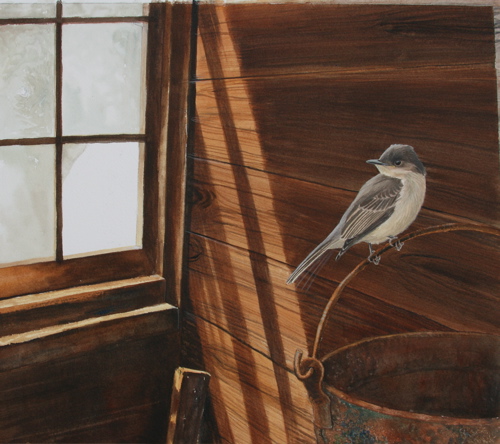
It's the morning of the third day of work. Now, I get to put the phoebe in. I don't really have that much to say about the process of painting the bird. I've been doing it for so many years that it happens very quickly. The only tricky part here is lighting it so it can sit believably in the scene. I'll talk more about that later. It's by no means done here, just blocked in to hold the space.
Back to the wood. I have a friend, Taff Roberts, who's a talented artist-woodcuts and writing-as well as being a housewright. Taff's from Wales. He showed me some of the woodgraining he's done while restoring old houses. In woodgraining, you take a surface that's bland and pointless, and you paint woodgrain on it until it looks like real wood paneling. It's not that hard. You use a broad brush dipped in different colors of paint, separate the bristles a bit, and run it horizontally over the surface, letting the brush bristles organically define the grain of your faux wood. This technique was used liberally in Victorian finishes, often on furniture made of wood without its own distinctive grain. It's clever, and it fools the eye amazingly well. This is what I did with this painting-make fake wood.
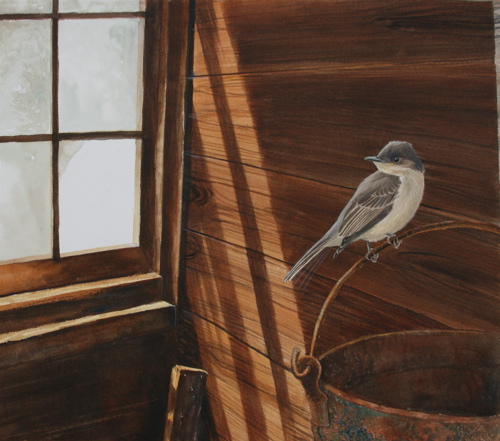 Here, it's very important to keep the wood grain lines consistent, so that the board planes are believable. Because I had masked it with film and masking compound, I painted over the bird quite freely, making sure there were no zones around its shape that might suggest I'd had to paint around it. The single most important thing I had to do in creating depth was make the boards behind the bird consistent. Any perturbation in their lines would make them "lift off" and make them come forward, instead of staying back behind the bird. Now that the bird was in, there would be no more broad brush strokes over it!
Another really important thing in making the shadows believable is running the woodgrain through them, so you can see the grain running through both darkness and light. Of course, the grain lines are darker in the shadows, and lighter in the light, but they are what make you believe that that's really a sunbeam playing over the surface, or a deep shadow. It's the change in the color of the grain lines, and the fact that you can still see them in the deep shadow, that really fools the eye. In all the overpainting, I was careful never to touch my sunbeams. Wouldn't want to dull that bright,warm color down. But I worked on the shadowed wood a lot.
I kept struggling with it, though, because my wood looked too fresh and new. It looked like cedar, and I wanted it to look like aged pine. So I kept taking darker and darker washes over it, ultramarine blue, and finally Chinese white to gray it out a bit.
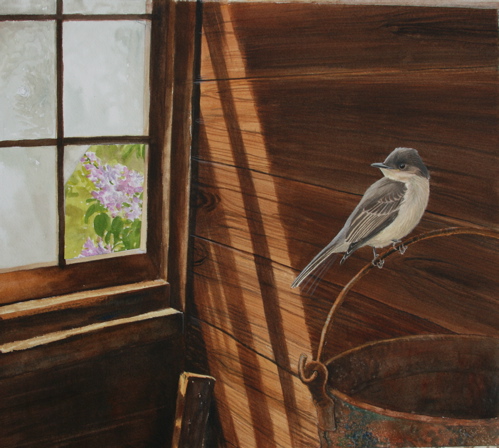
In fact, while the window looked cruddy and old, the whole right wall just looked too new. It was time for some cobwebs and crud. Up to this point, I'd painted everything transparently. Now, I got out my Chinese white, which is a color with some opaque body to it. I painted some of that nameless scuzz that hangs on barn walls-cobwebs and dust, I guess. I put some cobwebs in the corners. Fun!
Bill was working at home, so I kept taking the painting to him for suggestions. He caught a bunch of things-wavering lines, nuances of color that suggested that the boards were new rather than aged. I made sure the parallax was right (see the fixed seam above the phoebe's head? It was fanning out too much and that ruined the perspective) and took washes of ultramarine blue over the cedar-red boards to age them. A few well-placed rusty nails helped with the age factor, and more crud hanging from the cracks. The space underneath the window looked dull and blank to me, so I went foraging out in the garage to see what was hanging on its walls. Ahh. An old crusty, rusty snaffle bit that we'd dug up while turning the garden. It's just half a snaffle bit. This is a horse bit that has a joint in the middle. Sometime in the last century it rusted in half. While I was at it, I painted another fake panel of lilacs for the window and taped it on, to make sure the concept was holding. It looked good, especially with the hazy suggestion of more lilacs in the pane directly above it. Again, the perfect subject for watercolor.
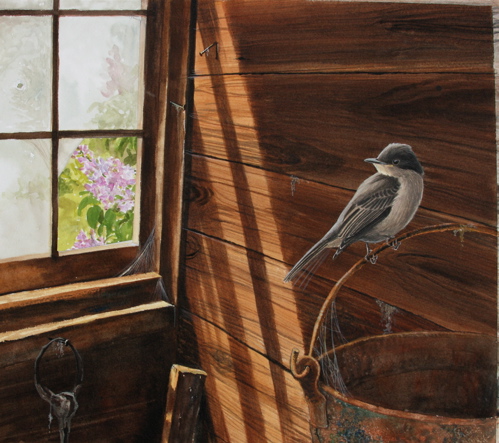 You can see in this image that I've darkened the bird a whole lot. I'd think I had it dark enough, and then I'd step back and it was still too lit up. I kept running violet and burnt umber and buffy gold and ultramarine streaks into its breast to darken it. Once he was nice and dark, boom, he suddenly fit into the scene. Compare this image with the one immediately above it if you don't think that helped. It's hard to go and make yourself paint shadow colors over a bird whose "local color" is technically "correct," but in order to make him inhabit the shadows, I've got to paint him lavender and gray and burnt umber. And that's what's really FUN.
 I saw a short film once about a Japanese couple who work together painting huge scenes on rice paper. She paints the figures, carefully constructing them, drawing their anatomy. And when she's done, he gets in there with great basins of wet paint and runs sloppy washes right over her carefully painted figures. She has to leave the room when he's altering her work. But she agrees that he improves the end product. That's the kind of tension that exists between the scientist in me (who knows what color a phoebe "is," or should be) and the artist, who knows that shadows have all the colors of the scene running through them, and knows how to inject mood into a scene. The scientist paints a correct phoebe, and the artist comes in, politely asks the scientist to get lost, and messes with the stage and the lighting.
Everything I'll do from here on out falls into the realm of fine-tuning. The painting is just about done, at the end of the third day. Got to make sure I don't get too carried away with cobwebs and crud. Just as I'm getting the hang of painting them, it's time to stop. Wouldn't want the phoebe to turn into Miss Haversham. Thanks to Big Stuff for your keen eye and helpful suggestions.
Labels: painting sunlight, painting wood, phoebes, Watercolor painting

posted by Julie Zickefoose @ 7:34 PM





<< Home